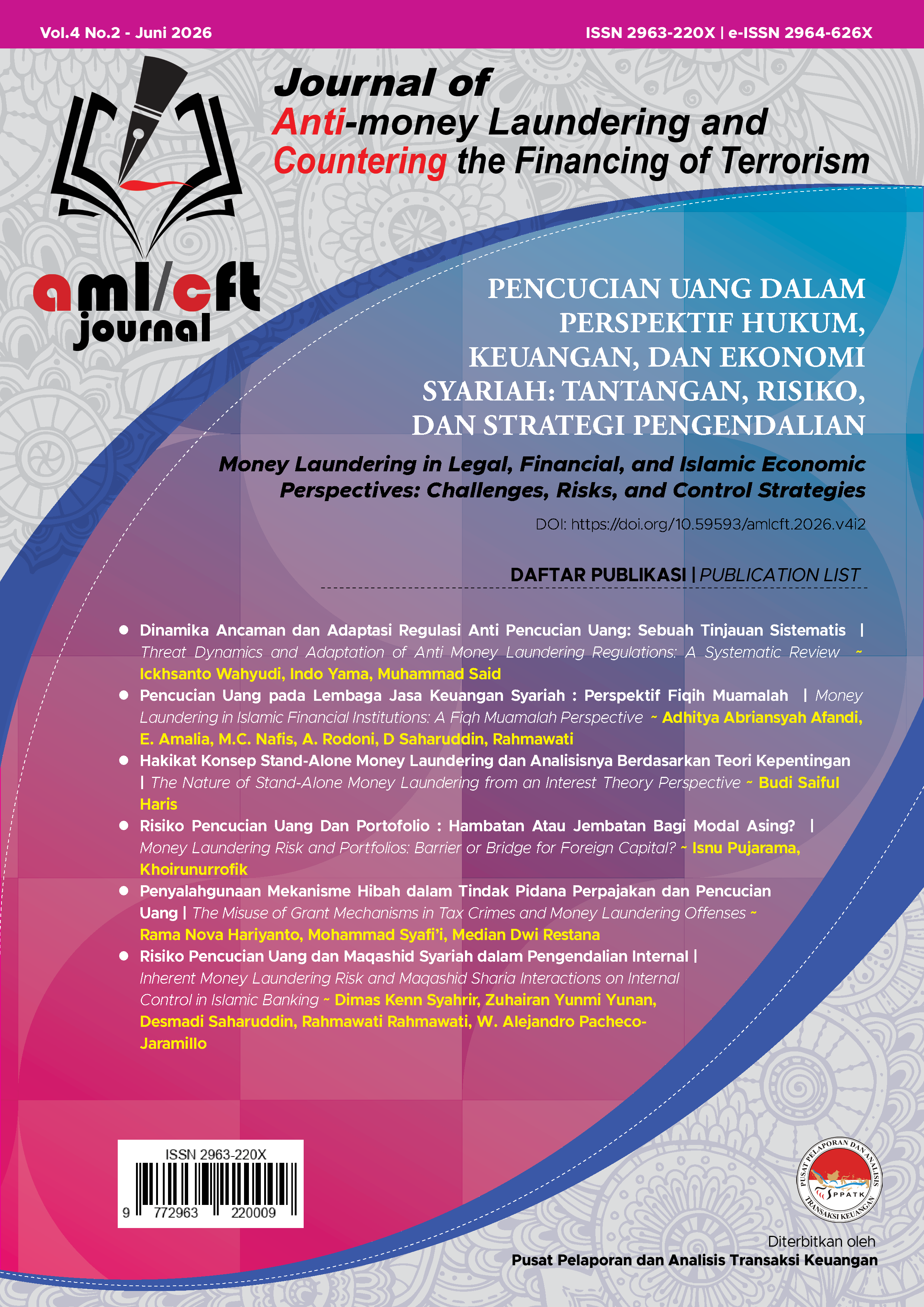
Dinamika Ancaman dan Adaptasi Regulasi Anti Pencucian Uang
Sebuah Tinjauan Sistematis
DOI:
https://doi.org/10.59593/amlcft.2026.v4i2.272Kata Kunci:
AML, Mata Uang Kripto, PRISMA, RegTechAbstrak
Praktik anti pencucian uang di Indonesia menghadapi tantangan kompleks yang dipicu oleh inovasi dalam praktik kejahatan keuangan. Penelitian ini memetakan ancaman, perkembangan hukum, dan respons teknologi dalam rezim anti pencucian uang nasional menggunakan metode Systematic Literature Review (SLR) berbasis pedoman PRISMA terhadap 25 artikel terindeks Scopus (2014-2025). Hasil penelitian merangkum empat temuan fundamental. Pertama, pola kejahatan bergeser ke arah aset digital seperti kripto dan platform daring, serta risiko yang berkaitan dengan kebijakan karbon. Kedua, adanya celah kerangka hukum terkait aset virtual dan penguatan alat bukti elektronik. Ketiga, meningkatnya kegunaan machine learning dan Regulatory Technology (RegTech) untuk mengoptimalkan deteksi dan compliance. Keempat, masih terdapat kesenjangan penelitian yang signifikan, meliputi studi empiris mengenai penyalahgunaan kripto dan pasar karbon yang terbatas, lemahnya analisis biaya-manfaat adopsi RegTech pada lembaga keuangan skala kecil dan menengah, serta minimnya perhatian terhadap aspek budaya dan perilaku dalam kepatuhan. Temuan ini menyajikan bukti komprehensif bagi perumus kebijakan dan lembaga keuangan. Efektivitas praktik anti pencucian uang di masa depan sangat bergantung pada regulasi yang adaptif, adopsi teknologi yang tepat sasaran, serta penguatan koordinasi antar pemangku kepentingan.
Unduhan
Referensi
Andiojaya, A., A. R. Ramadhani, R. Rizka, and F. Prachmasetiawan. “The Potential of Interprovincial Money Laundering in Indonesia: Investigation on the Attractiveness and Destination Choice.” Journal of Money Laundering Control 28, no. 1 (2025): 215–34. https://doi.org/10.1108/JMLC-04-2024-0080.
Arsyad, I., D. B. Kharisma, and J. Wiwoho. “Artificial Intelligence and Islamic Finance Industry: Problems and Oversight.” International Journal of Law and Management (2025). https://doi.org/10.1108/IJLMA-07-2024-0236.
Fauzi, F., K. Szulczyk, and A. Basyith. “Moving in the Right Direction to Fight Financial Crime: Prevention and Detection.” Journal of Financial Crime 25, no. 2 (2018): 362–68. https://doi.org/10.1108/JFC-06-2017-0060.
Fitriyanti, F., and M. A. Z. Nusantara. “Strengthening Anti-Money Laundering Framework in Online Banking: Bank Indonesia’s Initiatives and Countermeasures.” Jurnal Hukum Unissula 39, no. 2 (2023): 252–69. https://doi.org/10.26532/jh.v39i2.31970.
Griece Prasethio, P. F., and I. M. Murwantara. “Identifying Suspicious Financial Transaction Using Machine Learning and Pythagorean Tree.” In Proceedings of the 2024 2nd International Conference on Technology Innovation and Its Applications (ICTIIA 2024). Piscataway, NJ: Institute of Electrical and Electronics Engineers, 2024. https://doi.org/10.1109/ICTIIA61827.2024.10761346.
Gumbira, S. W., U. K. Pati, K. Tejomurti, and R. Nurhayati. “Assessing the Assurance of Legal Certainty and Equity of the Indonesian Law of Money Laundering.” Padjadjaran Jurnal Ilmu Hukum 9, no. 1 (2022): 1–23. https://doi.org/10.22304/pjih.v9n1.a1.
Hota, S. L., A. Kumar, A. Kumar, K. Ali, and S. S. Sakuntala. “Blockchain Technology and Its Potential to Mitigate Corruption in Banking.” In 2024 4th International Conference on Advancement in Electronics and Communication Engineering (AECE 2024), 1029–34. Piscataway, NJ: Institute of Electrical and Electronics Engineers, 2024. https://doi.org/10.1109/AECE62803.2024.10911834.
Husein, Y. “Combating Environmental Crime with Anti-Money Laundering Initiatives: Indonesian Experiences.” In Following the Proceeds of Environmental Crime: Forests, Fish and Filthy Lucre, 71–80. London: Taylor and Francis, 2014. https://doi.org/10.4324/9780203701812.
Jamil, A. Bin, R. J. Johari, A. Zarefar, and M. M. Yudi. “An Analysis of Suspicious Transaction Reporting Decisions in Malaysia’s Money Services Business.” Edelweiss Applied Science and Technology 8, no. 1 (2024): 24–32. https://doi.org/10.55214/25768484.v8i1.413.
Kasiyanto, S., and M. R. Kilinc. “The Legal Conundrums of the Metaverse.” Journal of Central Banking Law and Institutions 1, no. 2 (2022): 299–322. https://doi.org/10.21098/jcli.v1i2.25.
Latuihamallo, J. R., and I. Cahyaningtyas. “Electronic Evidence of Anti-Money Laundering Regimes: A Comparative Study between United Kingdom, United States and Indonesia.” Revista de Direito, Estado e Telecomunicacoes 16, no. 1 (2024): 189–220. https://doi.org/10.26512/lstr.v16i1.48449.
Lisanawati, G., and M. Kristina. “Anti-Money Laundering Law Strengthened on the Implementation of Carbon Tax in Indonesia.” Journal of Money Laundering Control 28, no. 2 (2025): 315–26. https://doi.org/10.1108/JMLC-05-2024-0089.
Lukito, A. S. “Financial Intelligent Investigations in Combating Money Laundering Crime: An Indonesian Legal Perspective.” Journal of Money Laundering Control 19, no. 1 (2016): 92–102. https://doi.org/10.1108/JMLC-09-2014-0029.
Meiryani, M., G. Soepriyanto, and J. Audrelia. “Effectiveness of Regulatory Technology Implementation in Indonesian Banking Sector to Prevent Money Laundering and Terrorist Financing.” Journal of Money Laundering Control 26, no. 4 (2023): 892–908. https://doi.org/10.1108/JMLC-04-2022-0059.
Mejri, M., H. B. Othman, B. Al-Shattarat, and K. Baatour. “Effect of Cultural Tightness-Looseness on Money Laundering: A Cross-Country Study.” Journal of Money Laundering Control 25, no. 2 (2022): 414–26. https://doi.org/10.1108/JMLC-03-2021-0025.
Nurillah, I., and T. Santoso. “Confidentiality of Banks as Modus Operandi by Gatekeepers in Money Laundering.” In Challenges of Law and Governance in Indonesia in the Disruptive Era I, 209–24. New York: Nova Science Publishers, 2021. https://www.scopus.com/inward/record.uri?eid=2-s2.0-85167774416&partnerID=40&md5=9120aff95d716982afdab9e0de1e494f.
Omar, N., I. B. Mohamed, Z. Mohd Sanusi, and H. Y. Prabowo. “Understanding Social Network Analysis (SNA) in Fraud Detection.” In Recent Trends in Social and Behaviour Sciences: Proceedings of the 2nd International Congress on Interdisciplinary Behavior and Social Sciences 2013 (ICIBSoS 2013), 543–48. Leiden: CRC Press/Balkema, 2014. https://doi.org/10.1201/b16658-99.
Otoritas Jasa Keuangan. Laporan Tahunan Otoritas Jasa Keuangan 2022. Jakarta: Otoritas Jasa Keuangan, 2023. https://www.ojk.go.id.
Otoritas Jasa Keuangan. Laporan Pengawasan Sektor Jasa Keuangan 2023. Jakarta: Otoritas Jasa Keuangan, 2023. https://www.ojk.go.id.
Pambudi, B. N., I. Hidayah, and S. Fauziati. “Improving Money Laundering Detection Using Optimized Support Vector Machine.” In 2019 2nd International Seminar on Research of Information Technology and Intelligent Systems (ISRITI 2019), edited by F. W. Wibowo, 273–78. Piscataway, NJ: Institute of Electrical and Electronics Engineers, 2019. https://doi.org/10.1109/ISRITI48646.2019.9034655.
Prabowo, A. “Money Laundering and Forensic Accounting in Indonesia: Postgraduate Perspective.” International Business Management 10, no. 23 (2016): 5633–42. https://doi.org/10.3923/ibm.2016.5633.5642.
Ramadhan, S. “Harnessing Machine Learning for Money Laundering Detection: A Criminological Theory-Centric Approach.” Journal of Money Laundering Control 28, no. 1 (2025): 184–201. https://doi.org/10.1108/JMLC-04-2024-0083.
Rusdiana, S., and W. Fitri. “Rethinking Indonesian Anti-Money Laundering Laws in the Age of Online Gaming Economies.” Nurani 24, no. 2 (2024): 360–74. https://doi.org/10.19109/nurani.v24i2.24422.
Wangga, M. S. E., D. A. D. Tawang, A. Sabirin, and A. H. Esquivel. “Criminal Liability of Political Parties from the Perspective of Anti-Money Laundering Act.” Journal of Indonesian Legal Studies 7, no. 1 (2022): 229–64. https://doi.org/10.15294/jils.v7i1.54534.
Wibowo, M. H. “Corporate Responsibility in Money Laundering Crime: Perspective Criminal Law Policy in Crime of Corruption in Indonesia.” Journal of Indonesian Legal Studies 3, no. 2 (2018): 213–36. https://doi.org/10.15294/jils.v3i02.22740.
Widhiyanti, H. N., S. M. Hussein, and R. Ganindha. “Indonesian Cryptocurrencies Legislative Readiness: Lessons from the United States.” Sriwijaya Law Review 7, no. 1 (2023): 150–75. https://doi.org/10.28946/slrev.Vol7.Iss1.2138.pp150-172.
Zarwono, E. E., and A. N. Hidayanto. “Analysis and Design of Internal Information Systems of the APU-PPT Education and Training Center Using the User-Centered Design Method.” In Proceedings of the 2nd International Conference on Informatics, Multimedia, Cyber, and Information System (ICIMCIS 2020), 159–65. Piscataway, NJ: Institute of Electrical and Electronics Engineers, 2020. https://doi.org/10.1109/ICIMCIS51567.2020.9354312.
Unduhan
Telah diserahkan
diterima
Diterbitkan
Cara Mengutip
Terbitan
Bagian
Lisensi
Hak Cipta (c) 2026 Ickhsanto Wahyudi, Indo Yama, Muhammad Said

Artikel ini berlisensiCreative Commons Attribution-ShareAlike 4.0 International License.
Hak cipta untuk artikel yang diterbitkan dalam Journal of Anti Money Laundering and Countering The Financing of Terrorism (AML CFT JOURNAL) tetap dimiliki oleh penulis. Sebelum publikasi artikel diterima, penulis berarti menyetujui lisensi Creative Commons CC-BY-SA (klik di sini untuk membaca teks lengkap ketentuan) dan juga perjanjian dengan pengelola jurnal. Lisensi Creative Commons memberikan hak umum untuk menyimpan, menerbitkan, mendistribusikan, mengakses, dan menggunakan artikel secara komersial.