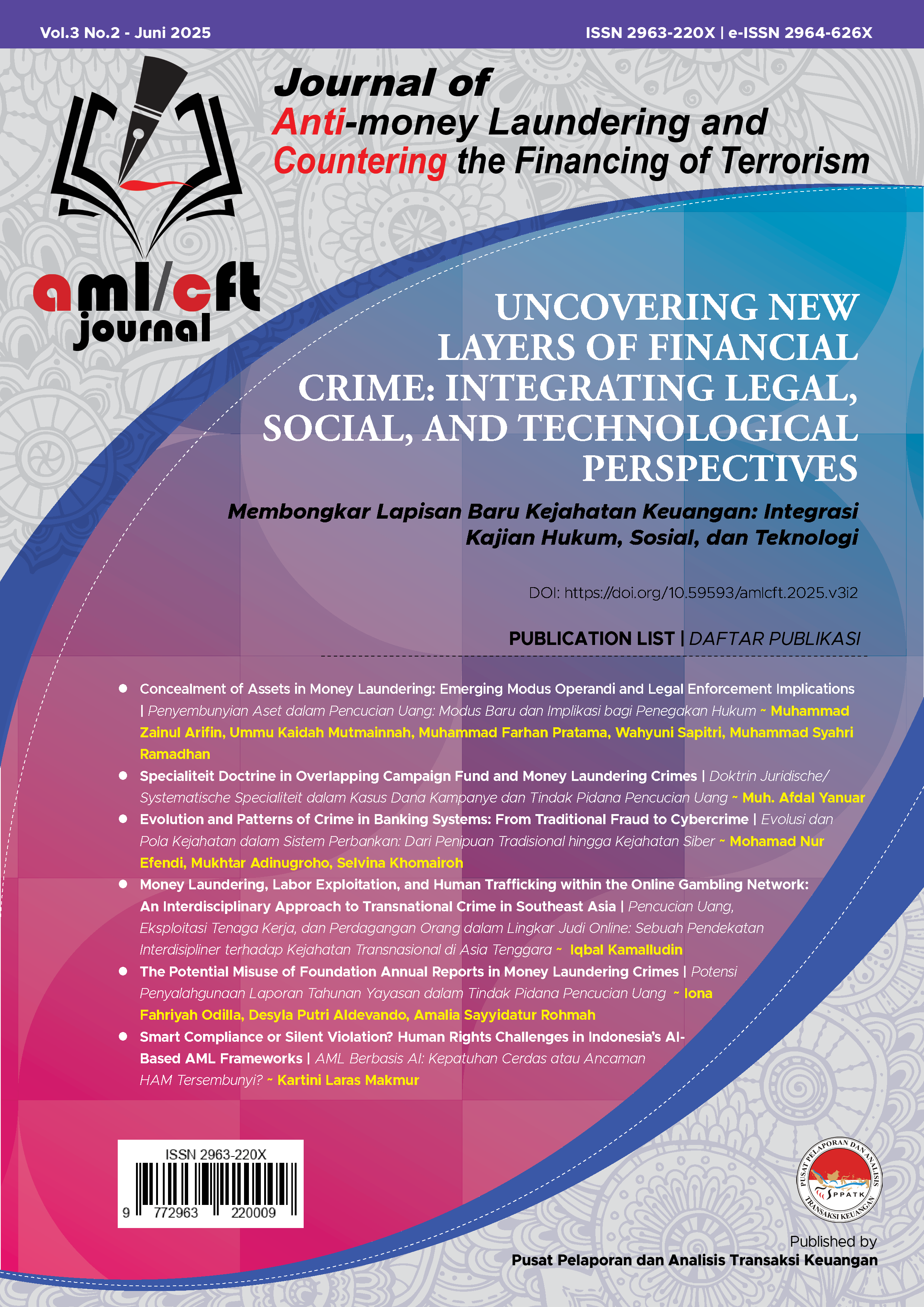
Smart Compliance or Silent Violation? Human Rights Challenges in Indonesia’s AI-Based AML Frameworks
DOI:
https://doi.org/10.59593/amlcft.2025.v3i2.251Keywords:
Artificial Intelligence, Human Rights, Money LaunderingAbstract
Artificial intelligence (AI) is increasingly used by banks to detect and prevent money laundering; however, the adoption of AI-based anti-money laundering (AML) frameworks raises significant concerns regarding human rights protection. This paper examines the ways in which AI enhances AML efforts in the banking sector, the ethical and human rights challenges that arise from its implementation, and the extent to which these strategies comply with the proportionality test under Indonesian human rights law. Using a structured document analysis of relevant regulations and secondary literature, this study finds that AI applications must respect privacy and be proportionate in addressing money laundering offences, as affirmed by the Indonesian constitution and regulatory framework. The findings highlight the urgent need for comprehensive legal frameworks to guide the development and use of AI in AML, ensuring fairness, accountability, and transparency while safeguarding human rights.
Downloads
References
Ahmed, Faraz. “Ethical Aspects of Artificial Intelligence in Banking.” Journal of Research in Economics and Finance Management 1, no. 2 (2022): 55–63. https://doi.org/10.56596/jrefm.v1i2.7.
Aluko, Ayodeji and Mahmood Bagheri. “Ethical Aspects of Artificial Intelligence in Banking.” Journal of Money Laundering Control 15, no. 4 (2012): 442–457. https://doi.org/10.1108/13685201211266024.
Bajgar, Ondrej, and Jan Horenovsky. “Negative Human Rights as a Basis for Long-Term AI Safety and Regulation.” Journal of Artificial Intelligence Research 76 (2023): 1043–75. https://doi.org/10.1613/jair.1.14020.
Bertrand, Astrid, Winston Maxwell, and Xavier Vamparys. “Are AI-Based Anti-Money Laundering Systems Compatible with Fundamental Rights?” Telecom Paris Research Paper Series November 2020. http://dx.doi.org/10.2139/ssrn.3647420.
Bieler, S. Alexandra. “Peeking into the House of Cards: Money Laundering, Luxury Real Estate, and the Necessity of Data Verification for the Corporate Transparency Act's Beneficial Ownership Registry.” Fordham Journal of Corporate and Financial Law 27, no. 85 (2021). https://heinonline.org/HOL/LandingPage?handle=hein.journals/fjcf27&div=7&id=&page=.
Chatterjee, Sheshadri, and Sreenivasulu N.S. “Artificial Intelligence and Human Rights: A Comprehensive Study from Indian Legal and Policy Perspective.” International Journal of Law and Management 64, no. 1 (2021): 110–34. https://doi.org/10.1108/ijlma-02-2021-0049.
Chitimira, Howard, Elfas Torerai, and Lisa Jana. “Leveraging Artificial Intelligence to Combat Money Laundering and Related Crimes in the South African Banking Sector.” Potchefstroom Electronic Law Journal 27 (September 10, 2024). https://doi.org/10.17159/1727-3781/2024/v27i0a18024.
Circiumaru, Alexandru. “Towards European AI: Part I - Setting the Context.” Qmul.ac.uk, October 18, 2019. https://www.qmul.ac.uk/euplant/blog/items/towards-european-ai-part-i---setting-the-context-.html.
Constitutional Court of the Republic of Indonesia. “Decision Number 14/PUU-VI/2008.” Mkri.id, 2020. https://en.mkri.id/court/decision?search=14%2FPUU-VI%2F2008.
Constitutional Court of the Republic of Indonesia. “The 1945 Constitution of the Republic of Indonesia,” 2020. https://en.mkri.id/library/constitution.
Conte, Alex. “Limiting Rights under International Law.” In Human Rights in the Prevention and Punishment of Terrorism Commonwealth Approaches: The United Kingdom, Canada, Australia and New Zealand, 283–314. Springer Nature, 2010. https://doi.org/10.1007/978-3-642-11608-7_10.
Dewi, Sinta, and Mohammad Wildan Hidayat. “Protection of Data Privacy in the Era of Artificial Intelligence in the Financial Sector in Indonesia.” Journal of Central Banking Law and Institutions 1, no. 2 (May 31, 2022). https://doi.org/10.21098/jcli.v1i2.18.
Digital Finance. “Asia Banks Spend $45 Billion on Compliance – for What?” Digital Finance, March 13, 2024. https://www.digfingroup.com/compliance-lexisnexis/.
FATF. “International Standards on Combating Money Laundering and the Financing of Terrorism & Proliferation,” 2023. https://www.fatf-gafi.org/content/dam/fatf-gafi/Recommendations/FATF%20Recommendations%202012.pdf.coredownload.inline.pdf.
Gupta, Abhishek, Dwijendra Nath Dwivedi, and Jigar Shah. Artificial Intelligence Applications in Banking and Financial Services. Future of Business and Finance. Springer, 2023. https://doi.org/10.1007/978-981-99-2571-1.
Gupta, Abhishek, Dwijendra Nath Dwivedi, and Ashish Jain. “Threshold Fine-Tuning of Money Laundering Scenarios through Multi-Dimensional Optimization Techniques.” Journal of Money Laundering Control, ahead-of-print, no. ahead-of-print (March 4, 2021). https://doi.org/10.1108/jmlc-12-2020-0138.
Hannan, Md. Abdul, Md. Atik Shahriar, Md. Sadek Ferdous, Mohammad Jabed, and Mohammad Shahriar Rahman. “A Systematic Literature Review of Blockchain-Based E-KYC Systems.” Computing 105 (April 13, 2023). https://doi.org/10.1007/s00607-023-01176-8.
Japanese Society for Artificial Intelligence. “The Japanese Society for Artificial Intelligence Ethical Guidelines,” 2017. https://www.ai-gakkai.or.jp/ai-elsi/wp-content/uploads/sites/19/2017/05/JSAI-Ethical-Guidelines-1.pdf.
Jullum, Martin, Anders Løland, Ragnar Bang Huseby, Geir Ånonsen, and Johannes Lorentzen. “Detecting Money Laundering Transactions with Machine Learning.” Journal of Money Laundering Control 23, no. 1 (January 4, 2020): 173–86. https://doi.org/10.1108/jmlc-07-2019-0055.
Kaur, Guneet. “Trust the Machine and Embrace Artificial Intelligence (AI) to Combat Money Laundering Activities.” In Computational Intelligence for Modern Business Systems Emerging Applications and Strategies, edited by Sandeep Kautish, Prasenjit Chatterjee, Dragan Pamucar, N. Pradeep, and Deepmala Singh, 63–81. Springer, 2024. https://doi.org/10.1007/978-981-99-5354-7_4.
Makmur, Kartini Laras. “Women and Dirty Money: How Women Are Affected By, Involved, and Counter Money Laundering.” Jurnal Hukum Prasada 9, no. 1 (March 14, 2022): 35–44. https://doi.org/10.22225/jhp.9.1.2022.35-44.
Makmur, Kartini, and Ahsanul Minan. “Money Laundering/Financing of Terrorism Risks in the Indonesian Islamic Banking System.” In Proceedings of the 3rd International Conference of Islamic Finance and Business. European Alliance for Innovation, 2023.
OECD. “AI Principles.” OECD, 2024. https://www.oecd.org/en/topics/sub-issues/ai-principles.html.
Prakarsa. “Highlighting Illicit Financial Flow of Indonesia's Top Six Export Commodities.” theparakarsa.org, November 2019.
Press, Gil. “Artificial Intelligence (AI) Defined.” Forbes, August 28, 2017. https://www.forbes.com/sites/gilpress/2017/08/27/artificial-intelligence-ai-defined/.
Quintavalla, Alberto, and Jeroen Temperman, eds. Human Rights and Artificial Intelligence. Oxford University Press, USA, 2023.
Schlink, Bernhard. “Proportionality in Constitutional Law: Why Everywhere but Here?” Duke Journal of Comparative & International Law 22, no. 10 (2012). https://scholarship.law.duke.edu/cgi/viewcontent.cgi?article=1290&context=djcil.
Sieckmann, Jan. “Proportionality as a Universal Human Rights Principle.” In Proportionality in Law, edited by David Duarte and Jorge Silva Sampaio, 3–24. Springer, 2018. https://doi.org/10.1007/978-3-319-89647-2_1.
Śliwiński, Emil. “Principle of Proportionality as a Threat to Criminal-Law-Related Fundamental Rights.” New Journal of European Criminal Law 14, no. 3 (February 10, 2023): 203228442311583. https://doi.org/10.1177/20322844231158323.
Sullivan, Morgan. “Big Tech’s Evolving Role in AI Governance: Shaping Ethical Standards.” Transcend Blog, March 21, 2024. https://transcend.io/blog/big-tech-ai-governance.
The European Parliament and The Council. “2016/679 General Data Protection Regulation,” 2016.
The Senate of The United States. “Bill to Provide a Framework for Artificial Intelligence Innovation and Accountability, and for Other Purposes,” November 15, 2023. https://www.congress.gov/118/bills/s3312/BILLS-118s3312is.pdf.
UN Human Rights Committee. “General Comment No. 31 [80], the Nature of the General Legal Obligation Imposed on States Parties to the Covenant.” Refworld, May 26, 2004. https://www.refworld.org/legal/general/hrc/2004/en/52451.
United Nations. “Universal Declaration of Human Rights.” United Nations, 1948. https://www.un.org/en/about-us/universal-declaration-of-human-rights.
Yeoh, Peter. “Banks’ Vulnerabilities to Money Laundering Activities.” Journal of Money Laundering Control 23, no. 1 (December 19, 2019): 122–35. https://doi.org/10.1108/jmlc-05-2019-0040.
Downloads
Submitted
Published
How to Cite
Issue
Section
License
Copyright (c) 2025 Kartini Laras Makmur

This work is licensed under a Creative Commons Attribution-ShareAlike 4.0 International License.
Authors who publish with this journal agree to the following terms:
Authors retain copyright and grant the journal right of first publication with the work simultaneously licensed under a Creative Commons Attribution-ShareAlike 4.0 International License that allows others to share the work with an acknowledgement of the work's authorship and initial publication in this journal.
Authors are able to enter into separate, additional contractual arrangements for the non-exclusive distribution of the journal's published version of the work (e.g., post it to an institutional repository or publish it in a book), with an acknowledgement of its initial publication in this journal.