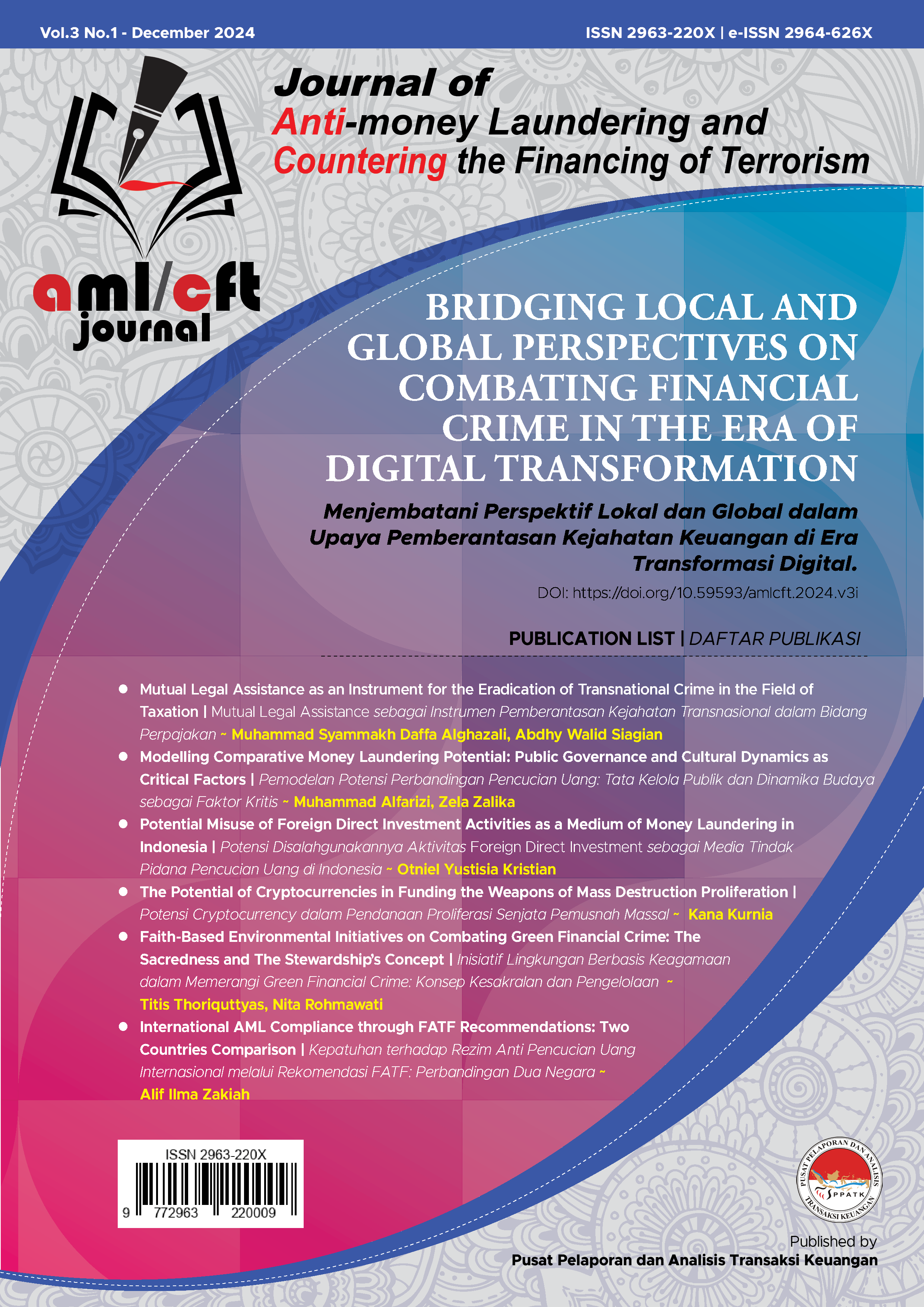
Pemodelan Potensi Perbandingan Pencucian Uang
Tata Kelola Publik dan Dinamika Budaya sebagai Faktor Kritis
DOI:
https://doi.org/10.59593/amlcft.2024.v3i1.192Kata Kunci:
Asia, Dinamika Budaya, Eropa, Pencucian Uang, Tata Kelola PublikAbstrak
Korupsi dan pencucian uang menjadi perhatian global karena dampaknya terhadap ekonomi, khususnya kawasan Asia dan Eropa. Sejarah literatur tentang faktor-faktor kejahatan keuangan melibatkan berbagai perspektif seperti perilaku, sosial, dan budaya. Studi ini bertujuan menyelidiki hubungan antara dimensi budaya nasional, tata kelola publik, dan potensi pencucian uang di Asia dan Eropa melalui pendekatan kuantitatif dengan analisis data sekunder dari Indeks Anti-Pencucian Uang (AML-Index) 2023. Structural Equation Modelling-Partial Least Square (SEM-PLS) digunakan untuk analisis, dengan menggunakan teknik estimasi likelihood maksimum. Pengujian hipotesis menunjukkan bahwa dinamika budaya secara signifikan dan positif mempengaruhi tata kelola publik. Namun, tata kelola publik dan dinamika budaya tidak secara signifikan memengaruhi potensi pencucian uang. Uji mediasi mengungkapkan bahwa tata kelola publik memediasi hubungan antara dinamika budaya dan potensi pencucian uang di kedua wilayah. Uji Multigroup Analysis (MGA) mengonfirmasi perbedaan signifikan antara Asia dan Eropa terkait pengaruh tata kelola publik terhadap potensi pencucian uang. Hasil ini sekaligus menunjukkan pentingnya penekanan kerja sama, edukasi publik, peningkatan tata kelola, kemajuan teknologi, dan kolaborasi internasional, yang menggambarkan strategi multifaset untuk secara efektif melawan pencucian uang global. Rekomendasi untuk Financial Action Task Force (FATF) dalam upaya mitigasi dan pencegahan pencucian uang global dapat berfokus pada kolaborasi lintas negara dan peningkatan tata kelola publik.
Unduhan
Referensi
Afthanorhan, Asyraf, Zainudin Awang, and Nazim Aimran. "An Extensive Comparison of Cb-Sem and Pls-Sem for Reliability and Validity." International Journal of Data and Network Science 4, no. 4 (2020): 357-64. https://doi.org/10.5267/j.ijdns.2020.9.003
AlQudah, Anas, Ahmed Bani‐Mustafa, Khalil Nimer, Abdullah D Alqudah, and Mostafa E AboElsoud. "The Effects of Public Governance and National Culture on Money Laundering: A Structured Equation Modelling Approach." Journal of Public Affairs 22 (2022): e2796. https://doi.org/10.1002/pa.2796
Awaah, Fred, and Morounkeji Olanrewaju. "Indigenous Cultures and Employee Efficiency: The Moderating Effect of Cronyism in State-Owned Enterprises in Ghana." Public Administration and Policy 26, no. 3 (November 13, 2023): 345-59. https://doi.org/10.1108/PAP-08-2022-0096
Basel Institute on Governance. "Basel AML Index - Assessing Money Laundering Risks around the World," 2023. https://index.baselgovernance.org/.
Blanco, D V. "Anti-Money Laundering Governance in the Philippines: Legal Foundations, Institutional Dynamics and Policy Challenges." Asia Pacific Journal of Public Administration 39, no. 1 (2017): 51-62. https://doi.org/10.1080/23276665.2017.1290901
Calafos, M W, and G Dimitoglou. "Cyber Laundering: Money Laundering from Fiat Money to Cryptocurrency." In Principles and Practice of Blockchains, 271-300, 2022. https://doi.org/10.1007/978-3-031-10507-4_12
D'Avino, C. "Money Laundering and AML Regulatory and Judicial System Regimes: Investigation of FinCEN Files." European Journal of Law and Economics 55, no. 2 (2023): 195-223. https://doi.org/10.1007/s10657-022-09756-3
Evan, Tomáš, and Vladimír Holý. "Cultural Diversity and Its Impact on Governance." Socio-Economic Planning Sciences 89 (October 2023): 101681. https://doi.org/10.1016/j.seps.2023.101681
Feng, G, S Hao, and X Li. "Project Sustainability and Public-Private Partnership: The Role of Government Relation Orientation and Project Governance." Sustainability (Switzerland) 14, no. 8 (2022). https://doi.org/10.3390/su14084724
Getie Mihret, Dessalegn. "National Culture and Fraud Risk: Exploratory Evidence." Journal of Financial Reporting and Accounting 12, no. 2 (2014): 161-76. https://doi.org/10.1108/JFRA-10-2012-0049
Ghulam, Yaseen, and Blandina Szalay. "Investigating the Determinants of Money Laundering Risk." Journal of Money Laundering Control 27, no. 1 (January 2, 2024): 139-57. https://doi.org/10.1108/JMLC-01-2023-0001
Gottschalk, Petter, and Lars Glasø. "Corporate Crime Does Pay! The Relationship between Financial Crime and Imprisonment in White-Collar Crime." International Letters of Social and Humanistic Sciences 5 (2013): 63-78. https://doi.org/10.18052/www.scipress.com/ILSHS.5.63
Hair, Joe F, Jeffrey Joe Risher, Marko Sarstedt, and Christian M Ringle. "The Results of PLS-SEM Article Information." European Business Review 31, no. 1 (2018): 2-24. https://doi.org/10.1108/EBR-11-2018-0203
Hofstede, Geert. "Dimensionalizing Cultures: The Hofstede Model in Context." Online Readings in Psychology and Culture 2, no. 1 (2011): 8. https://doi.org/10.9707/2307-0919.1014
---. "What Did GLOBE Really Measure? Researchers' Minds versus Respondents' Minds." Journal of International Business Studies 37 (2006): 882-96. https://doi.org/10.1057/palgrave.jibs.8400233
Holtfreter, Kristy. "General Theory, Gender-Specific Theory, and White-Collar Crime." Journal of Financial Crime 22, no. 4 (2015): 422-31. https://doi.org/10.1108/JFC-12-2014-0062
Jaffery, I H, and R A L Mughal. "Money-Laundering Risk and Preventive Measures in Pakistan." Journal of Money Laundering Control 23, no. 3 (2020): 699-714. https://doi.org/10.1108/JMLC-02-2020-0016
Kock, Ned. "Should Bootstrapping Be Used in Pls-Sem? Toward Stable p-value Calculation Methods." Journal of Applied Structural Equation Modelling 2, no. 1 (2018): 1-12. https://doi.org/10.47263/JASEM.2(1)02
Kramer, J.-A., A A J Blokland, E R Kleemans, and M R J Soudijn. "Money Laundering as a Service: Investigating Business-like Behavior in Money Laundering Networks in the Netherlands." Trends in Organized Crime, 2023. https://doi.org/10.1007/s12117-022-09475-w
Lamberti, G. "Hybrid Multigroup Partial Least Squares Structural Equation Modelling: An Application to Bank Employee Satisfaction and Loyalty." Quality and Quantity, 2021. https://doi.org/10.1007/s11135-021-01096-9
Levi, Michael. "Evaluating the Control of Money Laundering and Its Underlying Offences: The Search for Meaningful Data." Asian Journal of Criminology 15, no. 4 (December 20, 2020): 301-20. https://doi.org/10.1007/s11417-020-09319-y
Mahendra, Mahendra, Hambali Yusuf, Helwan Kasra, and Abdul Latif Mahfuz. "Pemberantasan Tindak Pidana Pencucian Uang Berdasarkan Undang-Undang Nomor 8 Tahun 2010 Tentang Pencegahan Dan Pemberantasan Tindak Pidana Pencucian Uang." Jurnal Darma Agung 30, no. 3 (2023): 1444-55. https://doi.org/10.28946/lexl.v3i3.1342
Matthews, Lucy. "Applying Multigroup Analysis in PLS-SEM: A Step-by-Step Process." In Partial Least Squares Path Modelling, 219-43. Cham: Springer International Publishing, 2017. https://doi.org/10.1007/978-3-319-64069-3_10
Meuleman, Louis. "The Cultural Dimension of Metagovernance: Why Governance Doctrines May Fail." Public Organization Review 10, no. 1 (March 13, 2010): 49-70. https://doi.org/10.1007/s11115-009-0088-5
Nazar, Sadia, Abdul Raheman, and Muhammad Anwar ul Haq. "The Magnitude and Consequences of Money Laundering." Journal of Money Laundering Control, January 11, 2023. https://doi.org/10.1108/JMLC-09-2022-0139
Nazzari, M. "Lost in the Maze: Disentangling the Behavioral Variety of Money Laundering." European Journal on Criminal Policy and Research, 2023. https://doi.org/10.1007/s10610-023-09572-8
Nurillah, Isma, and Nashriana Nashriana. "Gatekeeper Dalam Skema Korupsi Dan Praktik Pencucian Uang." Simbur Cahaya 26, no. 2 (2020): 207-29.
Obe, Redentor Goncalinho Antonio, and Florianus Aloysius Nay. "Model Pemidanaan Terhadap Pelaku Tindak Pidana Korupsi Yang Dibarengi Dengan Tindak Pidana Pencucian Uang Melalui Platform Digital." Saraq Opat: Jurnal Administrasi Publik 4, no. 2 (2022): 125-32. https://doi.org/10.55542/saraqopat.v4i2.325
Ruiter, D W P. "Is Transaction Cost Economics Applicable to Public Governance?" European Journal of Law and Economics 20, no. 3 (2005): 287-303. https://doi.org/10.1007/s10657-005-4197-5
Rusanov, Georgy, and Yury Pudovochkin. "Money Laundering in the Modern Crime System." Journal of Money Laundering Control 24, no. 4 (January 1, 2021): 860-68. https://doi.org/10.1108/JMLC-08-2020-0085
Russo, Daniel, and Klaas-Jan Stol. "PLS-SEM for Software Engineering Research." ACM Computing Surveys 54, no. 4 (2021): 1-38. https://doi.org/10.1145/3447580
Saeidi, H. "Impacts of Psychological Behaviors of Managers on Money Laundering: Evidence from Iran Stock Exchange." Journal of Money Laundering Control 25, no. 1 (2022): 206-23. https://doi.org/10.1108/JMLC-01-2021-0001
Sanusi, Z M, Y C Adam, N.S.M.N. Azman, and N Mohamed. "Investigations and Charges of Money Laundering Cases under AMLATFA: Enforcement of Malaysia Central Bank." International Journal of Economics and Management 10, no. Specialissue2 (2016): 541-55. https://www.scopus.com/inward/record.uri?eid=2-s2.0-85017379275&partnerID=40&md5=4e4a6a4357a95daa74eee79946f7e7d7.
Sanyal, Rajib. "Determinants of Bribery in International Business: The Cultural and Economic Factors." Journal of Business Ethics 59 (2005): 139-45. https://doi.org/10.1007/s10551-005-3406-z
Sarstedt, Marko, Lăcrămioara Radomir, Ovidiu Ioan Moisescu, and Christian M. Ringle. "Latent Class Analysis in PLS-SEM: A Review and Recommendations for Future Applications." Journal of Business Research 138 (January 2022): 398-407. https://doi.org/10.1016/j.jbusres.2021.08.051
Sarstedt, Marko, Christian M. Ringle, Jun Hwa Cheah, Hiram Ting, Ovidiu I. Moisescu, and Lacramioara Radomir. "Structural Model Robustness Checks in PLS-SEM." Tourism Economics 26, no. 4 (2020): 531-54. https://doi.org/10.1177/1354816618823921
Schubring, Sandra, Iris Lorscheid, Matthias Meyer, and Christian M. Ringle. "The PLS Agent: Predictive Modelling with PLS-SEM and Agent-Based Simulation." Journal of Business Research 69, no. 10 (October 2016): 4604-12. https://doi.org/10.1016/j.jbusres.2016.03.052
Siahaan, Nikolas Hamonangan. "Keberadaan Kerah Putih Dibalik Kasus Pencucian Uang." Pusat Pelaporan dan Analisis Transaksi Keuangan, 2019. https://www.ppatk.go.id/siaran_pers/read/970/keberadaan-kerah-putih-dibalik-kasus-pencucian-uang.html.
Streukens, Sandra, and Sara Leroi-Werelds. "Bootstrapping and PLS-SEM: A Step-by-Step Guide to Get More out of Your Bootstrap Results." European Management Journal 34, no. 6 (2016): 618-32. https://doi.org/10.1016/j.emj.2016.06.003
Sutrisno, Sutrisno, Fenty Puluhulawa, and Lusiana Margareth Tijow. "Penerapan Asas Keadilan, Kepastian Hukum Dan Kemanfaatan Dalam Putusan Hakim Tindak Pidana Korupsi." Gorontalo Law Review 3, no. 2 (2020): 168-87.
The World Bank. "World Governance Indicator," 2023. https://databank.worldbank.org/.
Wong, L. "Money-Laundering in Southeast Asia: Liberalism and Governmentality at Work." Contemporary Politics 19, no. 2 (2013): 221-33. https://doi.org/10.1080/13569775.2013.785832
Yamen, Ahmed, Anas Al Qudah, Ahmed Badawi, and Ahmed Bani-Mustafa. "The Impact of National Culture on Financial Crime." Journal of Money Laundering Control 22, no. 2 (2019): 373-87. https://doi.org/10.1108/JMLC-01-2018-0004
---. "The Impact of National Culture on Financial Crime." Journal of Money Laundering Control 22, no. 2 (May 7, 2019): 373-87. https://doi.org/10.1108/JMLC-01-2018-0004
Zafarullah, Habib, and Halima Haque. "Policies, Instrumentalities, Compliance and Control: Combatting Money Laundering in Bangladesh." Journal of Money Laundering Control 26, no. 1 (January 2, 2023): 189-204. https://doi.org/10.1108/JMLC-10-2021-0109
Zhang, Xiaojuan, Farhan Khan, Xiaoguang Wang, and Changle Tang. "Exploring the Impact of National Culture on the Development of Open Government Data: A Cross-Cultural Analysis." Big Data & Society 10, no. 2 (July 25, 2023). https://doi.org/10.1177/20539517231206809
Zolkaflil, S, S N F Syed Mustapha Nazri, and N Omar. "Asset Recovery Practices in Combating Money Laundering: Evidence from FATF Mutual Evaluation Report of FATF Member Countries of Asia Pacific Region." Journal of Money Laundering Control 26, no. 1 (2023): 24-34. https://doi.org/10.1108/JMLC-11-2021-0127
Unduhan
Telah diserahkan
diterima
Diterbitkan
Cara Mengutip
Terbitan
Bagian
Lisensi
Hak Cipta (c) 2024 Muhammad Alfarizi, Zela Zalika

Artikel ini berlisensiCreative Commons Attribution-ShareAlike 4.0 International License.
Hak cipta untuk artikel yang diterbitkan dalam Journal of Anti Money Laundering and Countering The Financing of Terrorism (AML CFT JOURNAL) tetap dimiliki oleh penulis. Sebelum publikasi artikel diterima, penulis berarti menyetujui lisensi Creative Commons CC-BY-SA (klik di sini untuk membaca teks lengkap ketentuan) dan juga perjanjian dengan pengelola jurnal. Lisensi Creative Commons memberikan hak umum untuk menyimpan, menerbitkan, mendistribusikan, mengakses, dan menggunakan artikel secara komersial.