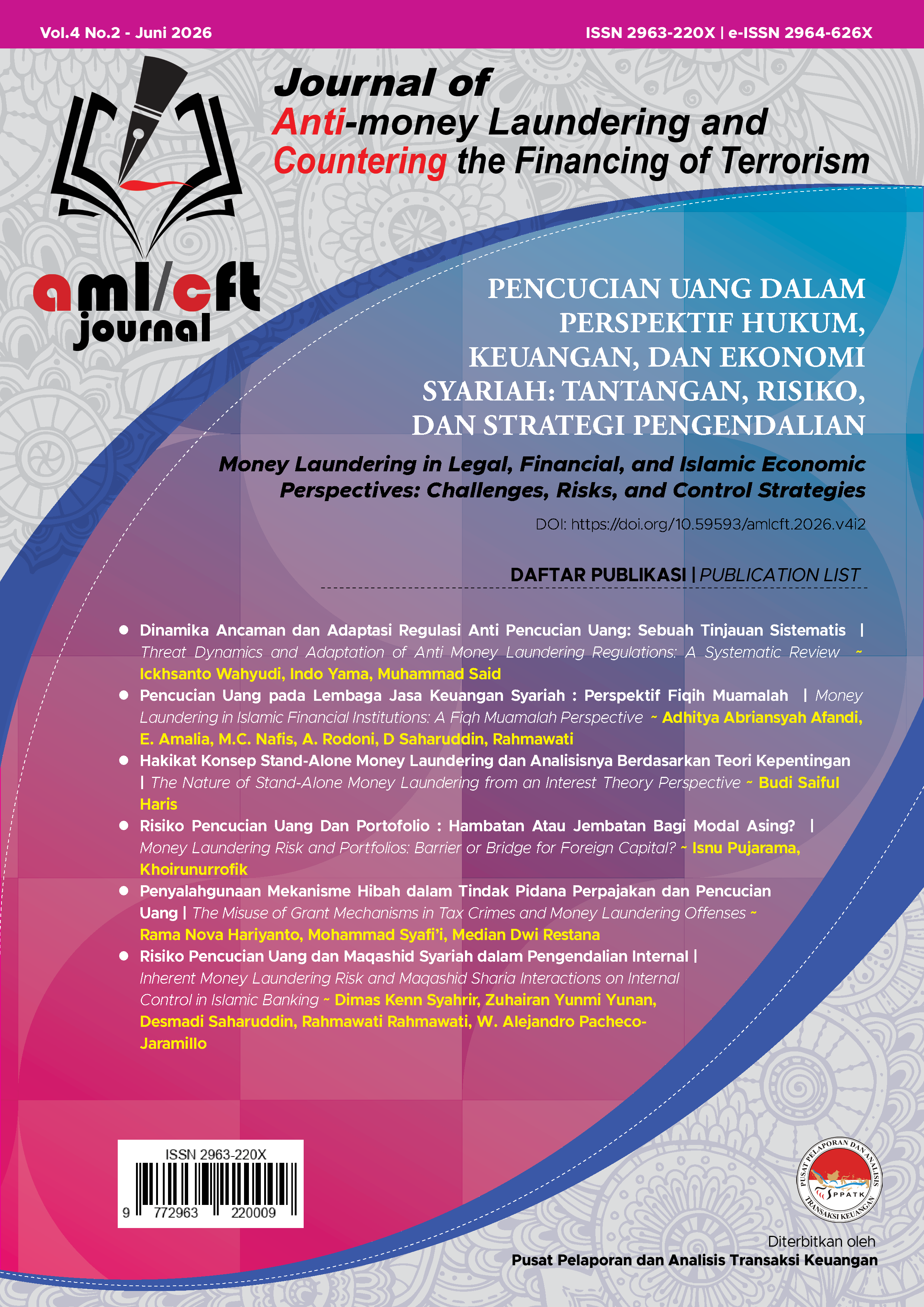
Money Laundering Risk and Foreign Portfolio Investment
Barrier or Bridge to International Capital Flows?
DOI:
https://doi.org/10.59593/amlcft.2026.v4i2.287Keywords:
Developed countries, developing countries, foreign portfolio investment, money laundering risk, two-step Generalized Method of Moments (GMM)Abstract
Foreign portfolio investment (FPI) is highly sensitive to money laundering risks, which degrade transparency, heighten market volatility, and erode investor confidence. However, existing research on anti-money laundering (AML) regulations primarily focuses on foreign direct investment (FDI) and the banking sector. However, foreign portfolio investment (FPI), being highly liquid and sensitive to governance risks, remains relatively underexplored in the anti-money laundering (AML) literature. Furthermore, cross-country variations in institutional capacity may generate heterogeneous effects, particularly between developed and developing economies. This study examines the linear and non-linear impacts of money laundering risk on FPI using panel data from 104 countries (2012–2021). To address endogeneity and cross-country heterogeneity, we employ a two-step Generalized Method of Moments (GMM) estimator. The findings are expected to provide empirical evidence for policymakers in designing financial supervisory systems that are proportionate and do not inadvertently undermine investment attractiveness. The results indicate that, in developing countries, foreign portfolio investment declines at low levels of money laundering risk up to a certain threshold, but increases once this threshold is exceeded. In developed countries, money laundering risk exhibits a non-linear effect on foreign portfolio investment. These findings suggest that policymakers must design proportionate AML frameworks to mitigate financial crimes without inadvertently stifling capital inflows critical for economic growth.
Downloads
References
Acemoglu, Daron, Simon Johnson, and James A. Robinson. “Institutions as a Fundamental Cause of Long-Run Growth.” In Handbook of Economic Growth, vol. 1, edited by Philippe Aghion and Steven N. Durlauf, 385–472. Amsterdam: Elsevier, 2005. https://doi.org/10.1016/S1574-0684(05)01006-3.
Agarwal, R. N. “Foreign Portfolio Investment in Some Developing Countries: A Study of Determinants and Macroeconomic Impact.” Indian Economic Review 32, no. 2 (1997): 217–29.
Agoba, Abel Mawuko, Joshua Yindenaba Abor, Kofi Osei, Jarjisu Sa-Aadu, Benjamin Amoah, and Gloria Clarissa Odortor Dzeha. “Central Bank Independence, Elections, and Fiscal Policy in Africa: Examining the Moderating Role of Political Institutions.” International Journal of Emerging Markets 14, no. 5 (2019): 809–30. https://doi.org/10.1108/IJOEM-08-2018-0423.
Ajide, K. B., and T. A. Ojeyinka. “Anti-Money Laundering Policy and Economic Governance in Africa.” Journal of Money Laundering Control 26, no. 1 (2023): 77–90.
Alfaro, Laura, Areendam Chanda, Sebnem Kalemli-Ozcan, and Selin Sayek. “FDI and Economic Growth: The Role of Local Financial Markets.” Journal of International Economics 64, no. 1 (October 2004): 89–112. https://doi.org/10.1016/S0022-1996(03)00081-3.
Antwi, Samuel, Anthony Buawolor Tetteh, Patience Armah, and Eric Opoku Dankwah. “Anti-Money Laundering Measures and Financial Sector Development: Empirical Evidence from Africa.” Cogent Economics & Finance 11, no. 1 (2023): 2209957. https://doi.org/10.1080/23322039.2023.2209957.
Arellano, Manuel, and Stephen Bond. “Some Tests of Specification for Panel Data: Monte Carlo Evidence and an Application to Employment Equations.” The Review of Economic Studies 58, no. 2 (1991): 277–97. https://doi.org/10.2307/2297968.
Arellano, Manuel, and Olympia Bover. “Another Look at the Instrumental Variable Estimation of Error-Components Models.” Journal of Econometrics 68, no. 1 (1995): 29–51. https://doi.org/10.1016/0304-4076(94)01642-D.
Ariesiyani, Amarillys Enika Noora, and Lalu Garin Alham. “Money Laundering in APEC Countries: A Gravity Model Analysis of Attractiveness and Destination Choices.” AML/CFT Journal: The Journal of Anti Money Laundering and Countering the Financing of Terrorism 1, no. 2 (2023): 146–66. https://doi.org/10.59593/amlcft.2023.v1i2.56.
Asteriou, Dimitrios, and Stephen G. Hall. Applied Econometrics. 2nd ed. London: Palgrave Macmillan, 2011.
Beck, Thorsten, Asli Demirgüç-Kunt, and Ross Levine. “A New Database on the Structure and Development of the Financial Sector.” The World Bank Economic Review 14, no. 3 (2000): 597–605. https://doi.org/10.1093/wber/14.3.597.
Beck, Thorsten, Asli Demirgüç-Kunt, and Ross Levine. “Bank Concentration, Competition, and Crises: First Results.” Journal of Banking & Finance 30, no. 5 (2006): 1581–603. https://doi.org/10.1016/j.jbankfin.2005.05.010.
Beck, Thorsten, Ross Levine, and Norman Loayza. “Finance and the Sources of Growth.” Journal of Financial Economics 58, no. 1 (2000): 261–300. https://doi.org/10.1016/S0304-405X(00)00072-6.
Bekaert, Geert, and Campbell R. Harvey. “Foreign Speculators and Emerging Equity Markets.” The Journal of Finance 55, no. 2 (2000): 565–613. https://doi.org/10.1111/0022-1082.00220.
Blundell, Richard, and Stephen Bond. “Initial Conditions and Moment Restrictions in Dynamic Panel Data Models.” Journal of Econometrics 87, no. 1 (1998): 115–43. https://doi.org/10.1016/S0304-4076(98)00009-8.
Bonner, Sarah E., Zoe-Vonna Palmrose, and Susan M. Young. “Fraud Type and Auditor Litigation: An Analysis of SEC Accounting and Auditing Enforcement Releases.” The Accounting Review 73, no. 4 (1998): 503–32. https://doi.org/10.2308/TAR-1325294.
Brambor, Thomas, William Roberts Clark, and Matt Golder. “Understanding Interaction Models: Improving Empirical Analyses.” Political Analysis 14, no. 1 (2006): 63–82. https://doi.org/10.1093/pan/mpi014.
Buchanan, Bonnie. “Money Laundering: A Global Obstacle.” Research in International Business and Finance 18, no. 1 (2004): 115–27. https://doi.org/10.1016/j.ribaf.2004.02.001.
Bührer, Christian, Ivo Hubli, and Eliane Marti. “The Regulatory Burden in the Swiss Wealth Management Industry.” Financial Markets and Portfolio Management 19, no. 1 (2005): 99–108. https://doi.org/10.1007/s11408-005-2299-2.
Camanho, N., F. Silva, and J. Vicente. “The Long-Term Economic Impact of Foreign Portfolio Investment.” The Long-Term Economic Impact of Foreign Portfolio Investment, no. 3 (2022): 786–805.
Campos, Nauro F., and Jeffrey B. Nugent. “Aggregate Investment and Political Instability: An Econometric Investigation.” Economica 70, no. 279 (2003): 533–49. https://doi.org/10.1111/1468-0335.01081.
Chinn, Menzie D., and Hiro Ito. “What Matters for Financial Development? Capital Controls, Institutions, and Interactions.” Journal of Development Economics 81, no. 1 (2006): 163–92. https://doi.org/10.1016/j.jdeveco.2005.05.010.
Desai, Mihir A. The Corporate Profit Base, Tax Sheltering Activity, and the Changing Nature of Employee Compensation. Cambridge, MA: National Bureau of Economic Research, 2002. https://doi.org/10.3386/w8866.
Djankov, Simeon, Caralee McLiesh, and Rita Maria Ramalho. “Regulation and Growth.” Economics Letters 92, no. 3 (2006): 395–401. https://doi.org/10.1016/j.econlet.2006.03.021.
Durham, J. Benson. “Absorptive Capacity and the Effects of Foreign Direct Investment and Equity Foreign Portfolio Investment on Economic Growth.” European Economic Review 48, no. 2 (2004): 285–306. https://doi.org/10.1016/S0014-2921(02)00264-7.
Erb, Claude B., Campbell R. Harvey, and Tadas E. Viskanta. “Political Risk, Economic Risk, and Financial Risk.” Financial Analysts Journal 52, no. 6 (1996): 29–46. https://doi.org/10.2469/faj.v52.n6.2038.
Errunza, Vihang. “Foreign Portfolio Equity Investments, Financial Liberalization, and Economic Development.” Review of International Economics 9, no. 4 (2001): 703–26. https://doi.org/10.1111/1467-9396.00308.
Eulaiwi, Baban, Nihad Shareef Khalaf, Ahmed Al-Hadi, Lien Duong, and Grantley Taylor. “Money Laundering Governance and Income Shifting: Evidence from Australian Financial Institutions.” Economic Modelling 132 (2024): 106653. https://doi.org/10.1016/j.econmod.2024.106653.
Financial Action Task Force. FATF Annual Report 2019–2020. Paris: FATF/OECD, 2020.
Financial Action Task Force. International Standards on Combating Money Laundering and the Financing of Terrorism and Proliferation: The FATF Recommendations. Paris: FATF/OECD, 2012.
Froot, Kenneth A., Paul G. J. O’Connell, and Mark S. Seasholes. “The Portfolio Flows of International Investors.” Journal of Financial Economics 59, no. 2 (2001): 151–93. https://doi.org/10.1016/S0304-405X(00)00084-2.
Goldstein, Itay, and Assaf Razin. “An Information-Based Trade-Off between Foreign Direct Investment and Foreign Portfolio Investment.” Journal of International Economics 70, no. 1 (2006): 271–95. https://doi.org/10.1016/j.jinteco.2005.12.002.
Gupta, P., and S. Ahmed. “Regulatory Quality and Foreign Investment: Evidence from Emerging Markets.” Journal of Policy Modeling 42, no. 4 (2020): 776–96.
Haider, M., M. A. Hashmi, and M. Ahmed. “Macroeconomic and Institutional Determinants of Foreign Portfolio Investment.” Economic Modelling 58 (2016): 291–304.
Issah, Mohammed, Samuel Antwi, Solomon Kofi Antwi, and Patience Amarh. “Anti-Money Laundering Regulations and Banking Sector Stability in Africa.” Cogent Economics & Finance 10, no. 1 (2022): 2069207. https://doi.org/10.1080/23322039.2022.2069207.
Issaoui, Fakhri, Toumi Hassen, and Touili Wassim. “The Effects of Money Laundering (ML) on Growth: Application to the Gulf Countries.” International Journal of Cyber Warfare and Terrorism 7, no. 1 (2017): 13–24. https://doi.org/10.4018/IJCWT.2017010102.
Kang, M. “Anti-Money Laundering Regulation and Banking Behavior: Theory and Evidence.” Journal of Banking Regulation 19 (2018): 34–49.
Kar, Dev, and Joseph Spanjers. Illicit Financial Flows from Developing Countries: 2004–2013. Vol. 20. Washington, DC: Global Financial Integrity, 2015.
Kaufmann, Daniel, Aart Kraay, and Massimo Mastruzzi. “The Worldwide Governance Indicators: Methodology and Analytical Issues.” Hague Journal on the Rule of Law 3, no. 2 (2011): 220–46. https://doi.org/10.1017/S1876404511200046.
Khayat, M. “Trade Openness, Governance, and Foreign Investment: Evidence from MENA Countries.” Global Business Review 21, no. 2 (2020): 56–72.
Khelil, Imen, Hichem Khlif, and Imen Achek. “The Economic Consequences of Money Laundering: A Review of Empirical Literature.” Journal of Money Laundering Control 27, no. 5 (2024): 901–16. https://doi.org/10.1108/JMLC-09-2023-0143.
Khrawish, Husni Ali. “The Impact of Anti-Money Laundering on Investment Funding: Evidence from Jordanian Financial Institutions.” International Journal of Economics and Finance 6, no. 3 (2014): 227. https://doi.org/10.5539/ijef.v6n3p227.
Knack, Stephen, and Philip Keefer. “Institutions and Economic Performance: Cross-Country Tests Using Alternative Institutional Measures.” Economics & Politics 7, no. 3 (1995): 207–27. https://doi.org/10.1111/j.1468-0343.1995.tb00111.x.
Kwabi, Frank, Robert Faff, Andrew Marshall, and Chandra Thapa. “Sub-Optimal International Portfolio Allocations and the Cost of Capital.” Journal of Multinational Financial Management 35 (2016): 41–58. https://doi.org/10.1016/j.mulfin.2016.04.001.
La Porta, Rafael, Florencio Lopez-de-Silanes, Andrei Shleifer, and Robert W. Vishny. “The Quality of Government.” Journal of Law, Economics, and Organization 15, no. 1 (1999): 222–79. https://doi.org/10.1093/jleo/15.1.222.
Lane, Philip R., and Gian Maria Milesi-Ferretti. “The External Wealth of Nations Mark II: Revised and Extended Estimates of Foreign Assets and Liabilities, 1970–2004.” Journal of International Economics 73, no. 2 (2007): 223–50. https://doi.org/10.1016/j.jinteco.2007.02.003.
Law, Siong Hook, Hui Boon Tan, and W. N. W. Azman-Saini. “Financial Development and Income Inequality at Different Levels of Institutional Quality.” Emerging Markets Finance and Trade 50, no. sup1 (2014): 21–33. https://doi.org/10.2753/REE1540-496X5001S102.
Levi, Michael, and Peter Reuter. “Money Laundering.” Crime and Justice 34 (2006): 289–375. https://doi.org/10.1086/501508.
Loureiro, G. R., A. D. Araújo, and A. Pinho Neto. “The Economic Foundations of Anti-Money Laundering: A Pigovian Approach.” Journal of Money Laundering Control 18, no. 4 (2015): 442–53.
Masoud, N., and G. Hardaker. “The Impact of Foreign Portfolio Investment on Capital Markets: Evidence from Emerging Economies.” International Journal of Economics and Finance 4, no. 9 (2012): 1–15.
McCarthy, Killian J., Peter Van Santen, and Ingo Fiedler. “Modeling the Money Launderer: Microtheoretical Arguments on Anti-Money Laundering Policy.” International Review of Law and Economics 43 (2015): 148–55. https://doi.org/10.1016/j.irle.2014.04.006.
Meier, Christoph. “Aggregate Investor Confidence in the Stock Market.” SSRN Electronic Journal, ahead of print, 2015. https://doi.org/10.2139/ssrn.2721487.
Naheem, Mohammed Ahmad. “Money Laundering Using Investment Companies.” Journal of Money Laundering Control 18, no. 4 (2015): 438–46. https://doi.org/10.1108/JMLC-10-2014-0031.
Ofoeda, Isaac, Elikplimi Agbloyor, and Joshua Yindenaba Abor. “Financial Sector Development, Anti-Money Laundering Regulations, and Economic Growth.” International Journal of Emerging Markets 19, no. 1 (2024): 191–210. https://doi.org/10.1108/IJOEM-12-2021-1823.
Ofoeda, Isaac, Elikplimi K. Agbloyor, Joshua Y. Abor, and Kofi A. Osei. “Anti-Money Laundering Regulations and Financial Sector Development.” International Journal of Finance & Economics 27, no. 4 (2020): 4085–104. https://doi.org/10.1002/ijfe.2360.
Ofoeda, Isaac, Elikplimi Komla Agbloyor, and Joshua Yindenaba Abor. “How Do Anti-Money Laundering Systems Affect FDI Flows across the Globe?” Cogent Economics & Finance 10, no. 1 (2022): 2058735. https://doi.org/10.1080/23322039.2022.2058735.
Reuter, Peter, and Edwin M. Truman. Chasing Dirty Money: The Fight against Money Laundering. Washington, DC: Institute for International Economics, 2004.
Rodrik, Dani, Arvind Subramanian, and Francesco Trebbi. “Institutions Rule: The Primacy of Institutions over Geography and Integration in Economic Development.” Journal of Economic Growth 9, no. 2 (2004): 131–65. https://doi.org/10.1023/B:JOEG.0000031425.72248.85.
Roodman, David. “How to Do xtabond2: An Introduction to Difference and System GMM in Stata.” The Stata Journal: Promoting Communications on Statistics and Stata 9, no. 1 (2009): 86–136. https://doi.org/10.1177/1536867X0900900106.
Savona, Ernesto U., and Michele Riccardi. Assessing the Risks of Money Laundering: Concepts and Approaches. Cham: Springer, 2019.
Schneider, Friedrich, and Dominik H. Enste. “Shadow Economies: Size, Causes, and Consequences.” Journal of Economic Literature 38, no. 1 (2000): 77–114. https://doi.org/10.1257/jel.38.1.77.
Schnorrenberger, Tobias, and Jörg Meurer. “Political Risk and Foreign Portfolio Flows in Emerging Markets.” Applied Economics Letters 25, no. 5 (2018): 304–8.
Sharman, Jason. “Offshore and the New International Political Economy.” Review of International Political Economy 17, no. 1 (2010): 1–19. https://doi.org/10.1080/09692290802686940.
Sharman, Jason C., and David Chaikin. Corruption and Money Laundering: A Symbiotic Relationship. London: Palgrave Macmillan, 2009.
Šikman, Mile, and Miloš Grujić. “Relationship of Anti-Money Laundering Index with GDP, Financial Market Development, and Human Development Index.” Nauka, Bezbednost, Policija 26, no. 1 (2021): 21–33. https://doi.org/10.5937/nabepo26-29725.
Stasavage, David. “Private Investment and Political Institutions.” Economics & Politics 14, no. 1 (2002): 41–63. https://doi.org/10.1111/1468-0343.00099.
Stulz, René M. “The Limits of Financial Globalization.” The Journal of Finance 60, no. 4 (2005): 1595–638. https://doi.org/10.1111/j.1540-6261.2005.00775.x.
Thapa, Chandra, and Sunil Poshakwale. “Financial Market Development and Economic Volatility.” Journal of International Financial Markets, Institutions and Money 22, no. 1 (2012): 58–73.
Todaro, Michael P., and Stephen C. Smith. Economic Development. 12th ed. Boston: Pearson Education, 2015.
Wooldridge, Jeffrey M. Econometric Analysis of Cross Section and Panel Data. 2nd ed. Cambridge, MA: MIT Press, 2010.
Yuksel, Ulku, and Asli Yuksel-Mermod. “A Risky Mode of Foreign Market Entry: International Portfolio Investments.” Journal of Business & Economics Research 8, no. 8 (2010). https://doi.org/10.19030/jber.v8i8.746.
Zdanowicz, John S. “Trade-Based Money Laundering and Terrorist Financing.” Review of Law & Economics 5, no. 2 (2009): 855–78. https://doi.org/10.2202/1555-5879.1419.
Downloads
Submitted
Accepted
Published
How to Cite
Issue
Section
License
Copyright (c) 2026 Isnu Pujarama, Khoirunurrofik

This work is licensed under a Creative Commons Attribution-ShareAlike 4.0 International License.
Authors who publish with this journal agree to the following terms:
Authors retain copyright and grant the journal right of first publication with the work simultaneously licensed under a Creative Commons Attribution-ShareAlike 4.0 International License that allows others to share the work with an acknowledgement of the work's authorship and initial publication in this journal.
Authors are able to enter into separate, additional contractual arrangements for the non-exclusive distribution of the journal's published version of the work (e.g., post it to an institutional repository or publish it in a book), with an acknowledgement of its initial publication in this journal.