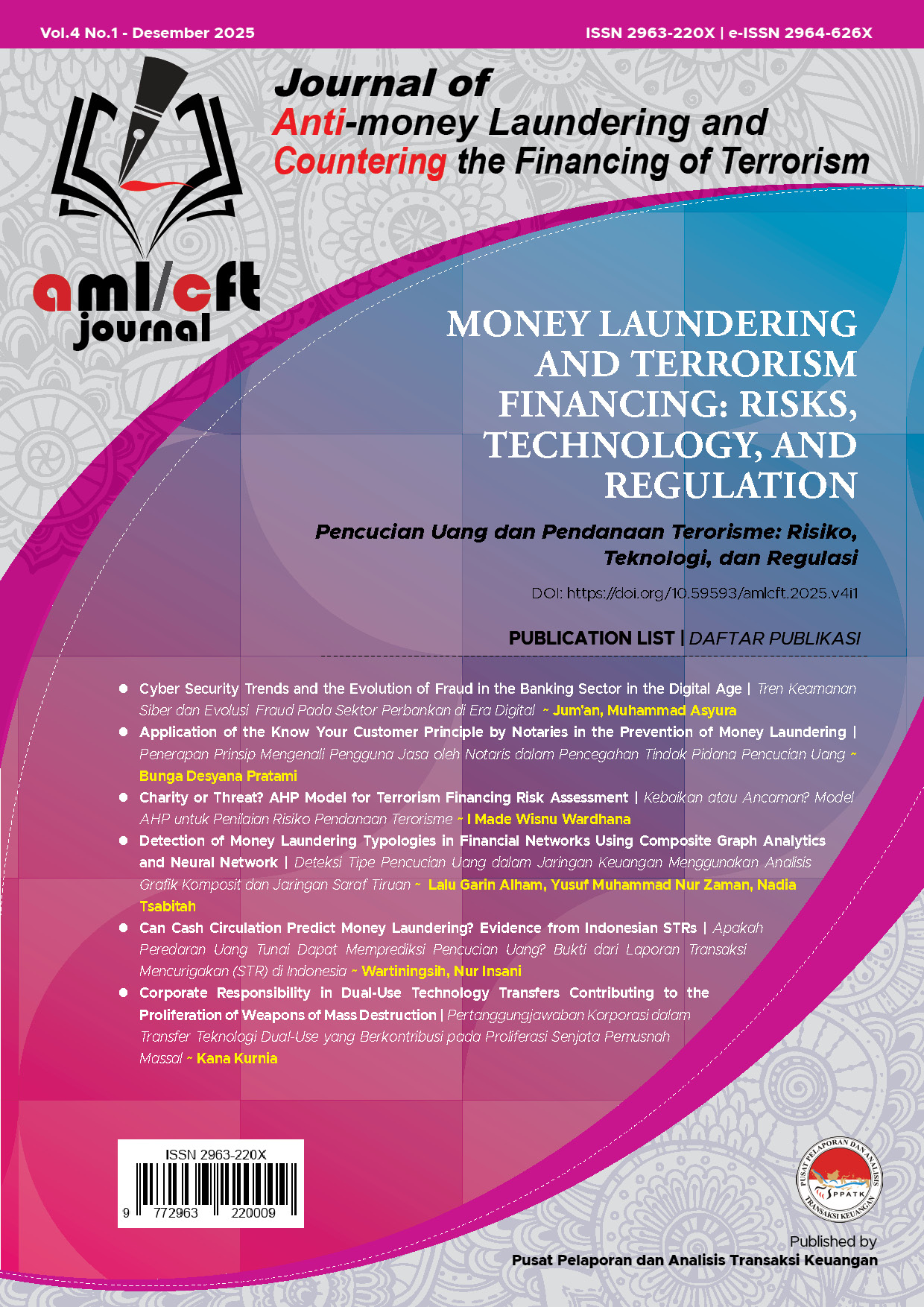
Money Laundering Typology Detection Using Graph Analytics and Neural Networks
DOI:
https://doi.org/10.59593/amlcft.2025.v4i1.269Keywords:
Financial Crime, Graph Theory, Machine Learning, Money LaunderingAbstract
Money laundering accounts for an estimated 2–5% of global GDP annually with scale intensified by digital ecosystems. Conventional AML systems using primarily rule-based and transactional patterns struggle to detect relational behaviors of financial crimes. This study introduces an integrated graph-analytic framework to detect structural laundering patterns using graph-derived metrics to neural network pipeline. The paper evaluates eccentricity, degree, closeness measures, and directionality of flow to distinguish laundering activities, supported by Welch’s t-test which confirms statistically significant differences across five of six metrics (p < 0.001). A Multi-Layer Perceptron (MLP) model is further applied to classify 17 typologies with ~80% accuracy. The key contribution of this research lies in demonstrating that financial crime typologies can be extracted from network topology itself instead of sole reliance on transactional features. By linking graph metrics with laundering behaviors including placement, layering, and integration patterns the study provides a scalable, network-aware approach to AML detection. Future work should focus on real-world validation and real-time classification pipelines using graph-neural inference.
Downloads
References
Alkaabi, Ali, George Mohay, Adrian McCullagh, and Nicholas Chantler. “A Comparative Analysis of the Extent of Money Laundering in Australia, UAE, UK and the USA.” SSRN Scholarly Paper No. 1539843. Rochester, NY: Social Science Research Network, 2010. https://doi.org/10.2139/ssrn.1539843.
APG. “About Anti-Money Laundering and Counter Terrorism Financing | Asia / Pacific Group On Money Laundering.” Last modified 2021. https://www.apgml.org/about-us/about-anti-money-laundering-and-counter-terrorism-financing.
Bakhshinejad, Nazanin, Reza Soltani, U. Nguyen, and Paul Messina. “A Survey of Machine Learning Based Anti-Money Laundering Solutions.” Internet of Things—Applications and Future (2022): 73–87.
Chainalysis Team. “2023 Crypto Crime Trends: Illicit Cryptocurrency Volumes Reach All-Time Highs Amid Surge in Sanctions Designations and Hacking.” Chainalysis. Last modified January 12, 2023. https://www.chainalysis.com/blog/2025-crypto-crime-report-introduction/.
Cheng, Dawei, Yujia Ye, Sheng Xiang, Zhenwei Ma, Ying Zhang, and Changjun Jiang. “Anti-Money Laundering by Group-Aware Deep Graph Learning.” IEEE Transactions on Knowledge and Data Engineering 35, no. 12 (2023): 12444–57. https://doi.org/10.1109/TKDE.2023.3272396.
Cloud, Katherine, and Ilya Brovin. “How Identity Fraud Is Changing in the Age of AI.” World Economic Forum. Last modified December 11, 2025. https://www.weforum.org/stories/2025/12/how-identity-fraud-is-increasing-in-the-age-of-ai/.
Collins, Jeffry. “Cryptocurrencies and Financial Crimes: The Role of Decentralized Cryptocurrency in Facilitating Money Laundering and the Challenges Posed on Anti–Money Laundering Regulations.” University of Miami Business Law Review 34, no. 1 (2025): 71.
Costa, Jacopo. “Research Case Study 3: Exposing the Networks behind Transnational Corruption and Money Laundering Schemes.” Basel Institute on Governance. Last modified May 31, 2023. https://baselgovernance.org/publications/research-case-3.
Deprez, Bruno, Toon Vanderschueren, Bart Baesens, Tim Verdonck, and Wouter Verbeke. “Network Analytics for Anti-Money Laundering—A Systematic Literature Review and Experimental Evaluation.” INFORMS Journal on Data Science (2025), https://doi.org/10.1287/ijds.2024.0042.
Euler, Leonhard. “Solutio Problematis Ad Geometriam Situs Pertinentis.” Euler Archive - All Works (1741): 128–40.
FATF - Egmont Group. FATF/Egmont Trade-Based Money Laundering: Trends and Developments. Paris: FATF - Egmont Group, 2020.
Gandhi, Hitarth, Kevin Tandon, Shilpa Gite, Biswajeet Pradhan, and Abdullah Alamri. “Navigating the Complexity of Money Laundering: Anti–Money Laundering Advancements with AI/ML Insights.” International Journal on Smart Sensing and Intelligent Systems 17, no. 1 (2024): 1–29. https://doi.org/10.2478/ijssis-2024-0024.
Jacomy, Mathieu, Tommaso Venturini, Sebastien Heymann, and Mathieu Bastian. “ForceAtlas2, a Continuous Graph Layout Algorithm for Handy Network Visualization Designed for the Gephi Software.” PLoS One 9, no. 6 (2014): e98679. https://doi.org/10.1371/journal.pone.0098679.
Miralis, Dennis, Harry Sultan, Henry Yu, and Zanthi Jordan. Anti-Money Laundering Laws and Regulations Anti-Money Laundering in the Asia-Pacific Region: An Overview 2025. London: International Comparative Legal Guides (ICLG), 2025.
Muminovic, Amel, and Festim Halili. “Money Laundering Prevention in the Digital Age: Leveraging Graph Databases for Effective Solutions.” Sciences (IJTNS) 4, no. 1 (2024): 1–10.
Newman, Mark E. J. Networks—An Introduction. Oxford: Oxford University Press, 2012.
Oztas, Berkan, Deniz Cetinkaya, Festus Adedoyin, Marcin Budka, Huseyin Dogan, and Gokhan Aksu. “Enhancing Anti-Money Laundering: Development of a Synthetic Transaction Monitoring Dataset.” 2023 IEEE International Conference on E-Business Engineering (ICEBE), November 2023, 47–54. https://doi.org/10.1109/ICEBE59045.2023.00028.
Popescu, Marius-Constantin, Valentina E. Balas, Liliana Perescu-Popescu, and Nikos Mastorakis. “Multilayer Perceptron and Neural Networks.” WSEAS Transactions on Circuits and Systems 8, no. 7 (2009): 579–88.
Rogers, Sam. “Cyber-Fraud, Underground Banking, and Technological Innovation Fuels Crime in SE Asia.” GASA. Last modified December 17, 2024. https://www.gasa.org/post/unodc-cyber-fraud-underground-banking-and-technological-innovation-fuels-crime-in-se-asia.
Tiwari, Milind, Jamie Ferrill, and Vishal Mehrotra. “Using Graph Database Platforms to Fight Money Laundering: Advocating Large Scale Adoption.” Journal of Money Laundering Control 26, no. 3 (2022): 474–87. https://doi.org/10.1108/JMLC-03-2022-0047.
UNODC. The Nexus Between Cybercrime and Corruption. Vienna: United Nations Office on Drugs and Crime, 2025.
Usman, Atif, Nasir Naveed, and Saima Munawar. “Intelligent Anti-Money Laundering Fraud Control Using Graph-Based Machine Learning Model for the Financial Domain.” Journal of Cases on Information Technology (JCIT) 25, no. 1 (2023): 1–20. https://doi.org/10.4018/JCIT.316665.
Vidovic, Tom. “The Rise of the Synthetic Identity: A Growing Threat in the Digital Age.” Global Compliance Institute. Last modified July 5, 2024. https://www.gci-ccm.org/.
Weber, Ryan, Iilpo Tammi, Shinan Wang, and Timothy Anderson. A Spatial Analysis of City-Regions: Urban Form & Service Accessibility. Stockholm: Nordregio, 2016.
Welch, B. L. “The Generalization of ‘Student’s’ Problem When Several Different Population Varlances Are Involved.” Biometrika 34, no. 1–2 (1947): 28–35. https://doi.org/10.1093/biomet/34.1-2.28.
World Bank. “Corrupt Money Concealed in Shell Companies and Other Opaque Legal Entities, Finds New StAR Study.” World Bank. Last modified October 24, 2011. https://doi.org/10/24/corrupt-money-concealed-in-shell-companies-and-other-opaque-legal-entities-finds-new-star-study.
World Economic Forum. Digital Transformation: Powering the Great Reset. Switzerland: World Economic Forum, 2020.
Downloads
Submitted
Accepted
Published
How to Cite
Issue
Section
License
Copyright (c) 2025 Lalu Garin Alham, Nadia Tsabitah, Yusuf Muhammad Nur Zaman

This work is licensed under a Creative Commons Attribution-ShareAlike 4.0 International License.
Authors who publish with this journal agree to the following terms:
Authors retain copyright and grant the journal right of first publication with the work simultaneously licensed under a Creative Commons Attribution-ShareAlike 4.0 International License that allows others to share the work with an acknowledgement of the work's authorship and initial publication in this journal.
Authors are able to enter into separate, additional contractual arrangements for the non-exclusive distribution of the journal's published version of the work (e.g., post it to an institutional repository or publish it in a book), with an acknowledgement of its initial publication in this journal.