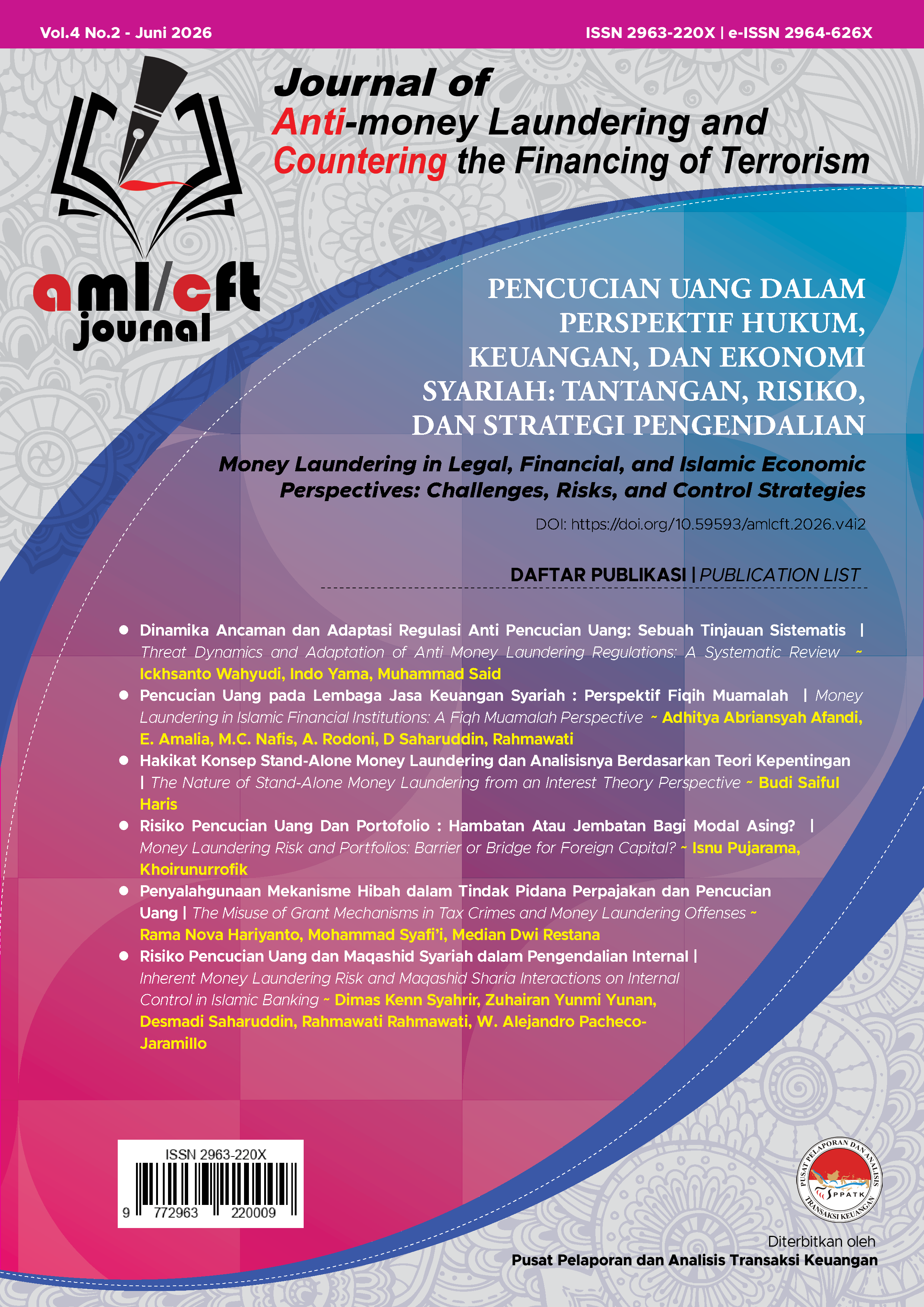
Risiko Pencucian Uang dan Maqashid Syariah dalam Pengendalian Internal
DOI:
https://doi.org/10.59593/amlcft.2026.v4i2.286Kata Kunci:
Maqashid Syariah, Pencucian Uang, Pengendalian Internal, Perbankan Syariah, Risiko InherenAbstrak
Risiko pencucian uang pada industri perbankan di Indonesia cenderung meningkat, sementara pelaporan transaksi keuangan mencurigakan (LTKM) oleh bank umum syariah menunjukkan pola yang fluktuatif dengan tren penurunan yang tajam. Namun, hubungan antara risiko inheren pencucian uang, prinsip maqashid syariah, dan pengendalian internal program APU/PPT pada perbankan syariah masih belum banyak dikaji. Penelitian ini bertujuan menganalisis pengaruh empat dimensi risiko inheren pencucian uang dan prinsip maqashid syariah terhadap pengendalian internal program APU/PPT, serta menguji peran maqashid syariah sebagai variabel moderasi. Penelitian menggunakan pendekatan kuantitatif dengan data dari 170 responden yang mewakili tiga lini pertahanan pada 13 bank umum syariah di Indonesia dan dianalisis menggunakan PLS-SEM. Hasil penelitian menunjukkan bahwa risiko nasabah, risiko produk/jasa/transaksi, dan risiko saluran distribusi berpengaruh signifikan terhadap pengendalian internal, sedangkan risiko negara tidak berpengaruh signifikan. Maqashid syariah berpengaruh signifikan sebagai variabel independen, tetapi tidak berperan sebagai variabel moderasi. Kebaruan penelitian ini terletak pada integrasi maqashid syariah dalam model pengendalian internal APU/PPT, yang mengindikasikan perlunya penerapan maqashid syariah secara simultan dengan pengendalian berbasis risiko, terutama dalam pengelolaan risiko nasabah.
Unduhan
Referensi
Alias, R. M. R., N. M. Yasin, B. H. Ibrahim, and M. Y. Z. Kepli. “Combating Money Laundering and Terrorism Financing: Perspectives from Maqāṣid al-Sharīʿah.” In Emerging Issues in Islamic Finance Law and Practice in Malaysia, 130–44. Bingley: Emerald Publishing Limited, 2019. https://doi.org/10.1108/978-1-78973-545-120191014.
Amos, M. Structural Equation Modeling: Publish Concept and Its Implementation in Management Science Studies. February 2021.
Auda, Jasser. Maqasid al-Shariah as Philosophy of Islamic Law: A Systems Approach. London: International Institute of Islamic Thought, 2008. https://doi.org/10.2307/j.ctvkc67tg.
Baron, R. M., and D. A. Kenny. “The Moderator-Mediator Variable Distinction in Social Psychological Research: Conceptual, Strategic, and Statistical Considerations.” Journal of Personality and Social Psychology 51, no. 6 (1986): 1173–82. https://doi.org/10.1037/0022-3514.51.6.1173.
Bollen, K. A. Structural Equations with Latent Variables. New York: Wiley, 1989. https://doi.org/10.1002/9781118619179.
Cohen, J. “A Power Primer.” Psychological Bulletin 112, no. 1 (1992): 155–59. https://doi.org/10.1037/0033-2909.112.1.155.
Committee of Sponsoring Organizations of the Treadway Commission. Internal Control—Integrated Framework: Executive Summary. COSO, 2013.
Edwards, J. R., and L. S. Lambert. “Methods for Integrating Moderation and Mediation: A General Analytical Framework Using Moderated Path Analysis.” Psychological Methods 12, no. 1 (2007): 1–22. https://doi.org/10.1037/1082-989X.12.1.1.
Fan, Y., J. Chen, G. Shirkey, R. John, S. R. Wu, H. Park, and C. Shao. “Applications of Structural Equation Modeling (SEM) in Ecological Studies: An Updated Review.” Ecological Processes 5, no. 1 (2016). https://doi.org/10.1186/s13717-016-0063-3.
Financial Action Task Force. International Standards on Combating Money Laundering and the Financing of Terrorism and Proliferation: The FATF Recommendations. Paris: FATF, 2023.
Gramling, A. A., E. O’Donnell, and S. D. Vandervelde. “An Experimental Examination of Factors That Influence Auditor Assessments of a Deficiency in Internal Control over Financial Reporting.” Accounting Horizons 27, no. 2 (2013): 249–69. https://doi.org/10.2308/acch-50410.
Hair, J. F., G. T. M. Hult, C. M. Ringle, and M. Sarstedt. A Primer on Partial Least Squares Structural Equation Modeling (PLS-SEM). 2nd ed. Thousand Oaks, CA: SAGE, 2017.
Hair, J. F., G. T. M. Hult, C. M. Ringle, M. Sarstedt, N. P. Danks, and S. Ray. Partial Least Squares Structural Equation Modeling (PLS-SEM) Using R. Cham: Springer, 2021. https://doi.org/10.1007/978-3-030-80519-7.
He, P. “A Typological Study on Money Laundering.” Journal of Money Laundering Control 13, no. 1 (2010): 15–32. https://doi.org/10.1108/13685201011010182.
Hoque, M. N., J. Said, M. F. Abdullah, and A. U. F. Ahmad. “Money Laundering from Maqāṣid al-Sharīʿah Perspective with a Particular Reference to Preservation of Wealth (Hifz al-Māl).” Journal of Legal, Ethical and Regulatory Issues 24, special issue 1 (2021): 1–10. https://doi.org/10.2139/ssrn.3209775.
Islam, M. “From Dirty Money to Luxury Goods: Money Laundering in UK Luxury Goods Sectors.” PhD diss., University of Leeds, 2022.
Klimova, S., N. Zhampeiis, and A. Grigoryan. “Contemporary Approaches to Money Laundering/Terrorism Financing Risk Assessment and Methods of Its Automation in Commercial Banks.” Procedia Computer Science 169 (2020): 380–87. https://doi.org/10.1016/j.procs.2020.02.233.
Knock, W., and A. Paramytish. “Jackknifing as an Alternative to Bootstrapping in PLS Path Modeling.” 2011.
Kock, N., and P. Hadaya. “Minimum Sample Size Estimation in PLS-SEM: The Inverse Square Root and Gamma-Exponential Methods.” Information Systems Journal 28, no. 1 (2018): 227–61. https://doi.org/10.1111/isj.12131.
Latan, H., and I. Ghozali. Partial Least Squares: Concept, Technique and Application Using SmartPLS. Semarang: Universitas Diponegoro, 2015.
Llabre, M. M., and W. Arguelles. “Structural Equation Modeling (SEM).” In Encyclopedia of Behavioral Medicine, edited by M. D. Gellman and J. R. Turner, 1917–19. New York: Springer, 2013. https://doi.org/10.1007/978-1-4419-1005-9_217.
Mekpor, E. S. “Anti-Money Laundering and Combating the Financing of Terrorism Compliance: Are FATF Member States Just Scratching the Surface?” Journal of Money Laundering Control 22, no. 3 (2019): 451–71. https://doi.org/10.1108/JMLC-09-2018-0057.
Mohammed, M. O., D. A. Razak, and F. M. Taib. “The Performance Measures of Islamic Banking Based on the Maqasid Framework.” Paper presented at the IIUM International Accounting Conference (INTAC IV), Putrajaya, Malaysia, 2008.
Mohd-Sanusi, Z., Y. Mat-Isa, A. H. Ahmad-Bakhtiar, Y. H. Mat-Jusoh, and T. Tarjo. “Interaction Effects of Professional Commitment, Customer Risk, Independent Pressure and Money Laundering Risk Judgment among Bank Analysts.” Journal of Money Laundering Control 25, no. 3 (2022): 493–510. https://doi.org/10.1108/JMLC-05-2021-0046.
Nofrianto, M. H., et al. “Implementation of Maqashid Sharia in Islamic Banking.” 2021.
Otoritas Jasa Keuangan. Peraturan Otoritas Jasa Keuangan Nomor 8 Tahun 2023 tentang Penerapan Program Anti Pencucian Uang, Pencegahan Pendanaan Terorisme, dan Pencegahan Pendanaan Proliferasi Senjata Pemusnah Massal di Sektor Jasa Keuangan. Jakarta: OJK, 2023.
Otoritas Jasa Keuangan and Pusat Pelaporan dan Analisis Transaksi Keuangan. Penilaian Risiko Sektoral Tindak Pidana Pencucian Uang dan Pendanaan Terorisme Sektor Jasa Keuangan. Jakarta: OJK and PPATK, 2017.
Pusat Pelaporan dan Analisis Transaksi Keuangan. Statistik Pelaporan Laporan Transaksi Keuangan Mencurigakan 2021–2023. Jakarta: PPATK, 2023.
Riccardi, M., R. Milani, and D. Camerini. “Assessing Money Laundering Risk across Regions: An Application in Italy.” European Journal on Criminal Policy and Research 25, no. 1 (2019): 21–43. https://doi.org/10.1007/s10610-018-9399-9.
Sam, I., and A. Sholeh. Ijtima’ Ulama Komisi Fatwa Se-Indonesia IV: Masalah-Masalah Fikih Kontemporer (Masail Fiqhiyyah Mu‘ashirah). 2012.
Xue, Y. W., and Y. H. Zhang. “Research on Money Laundering Risk Assessment of Customers: Based on the Empirical Research of China.” Journal of Money Laundering Control 19, no. 3 (2016): 249–63. https://doi.org/10.1108/JMLC-01-2015-0004.
Unduhan
Telah diserahkan
diterima
Diterbitkan
Cara Mengutip
Terbitan
Bagian
Lisensi
Hak Cipta (c) 2026 Dimas Kenn Syahrir, Zuhairan Yunmi Yunan, Desmadi Saharuddin, Rahmawati, Alejandro Pacheco-Jaramillo

Artikel ini berlisensiCreative Commons Attribution-ShareAlike 4.0 International License.
Hak cipta untuk artikel yang diterbitkan dalam Journal of Anti Money Laundering and Countering The Financing of Terrorism (AML CFT JOURNAL) tetap dimiliki oleh penulis. Sebelum publikasi artikel diterima, penulis berarti menyetujui lisensi Creative Commons CC-BY-SA (klik di sini untuk membaca teks lengkap ketentuan) dan juga perjanjian dengan pengelola jurnal. Lisensi Creative Commons memberikan hak umum untuk menyimpan, menerbitkan, mendistribusikan, mengakses, dan menggunakan artikel secara komersial.