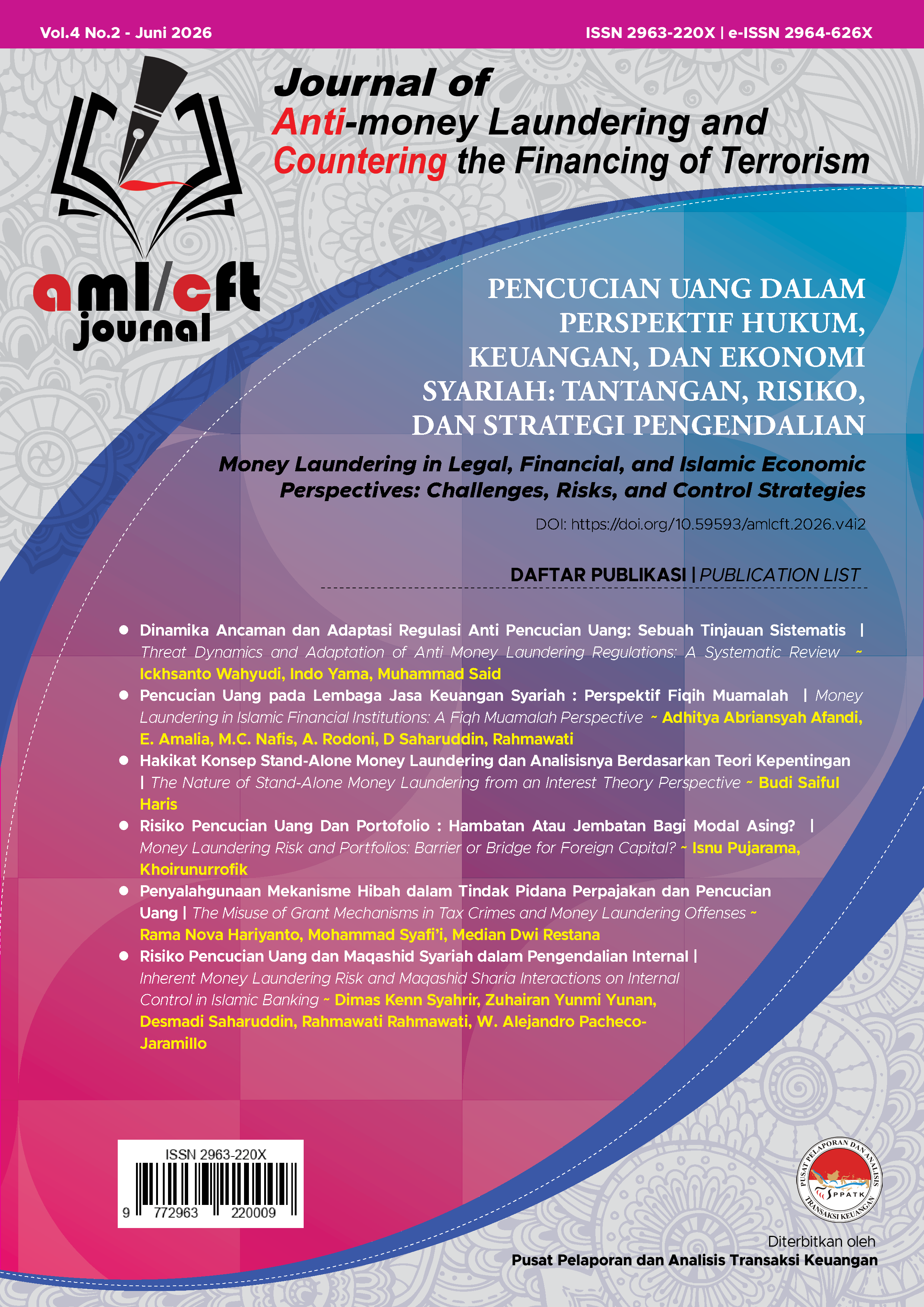
Threat Dynamics and Adaptation of Anti Money Laundering Regulations
A Systematic Review
DOI:
https://doi.org/10.59593/amlcft.2026.v4i2.272Keywords:
AML, Cryptocurrency, PRISMA, RegTechAbstract
Money laundering in Indonesia faces complex challenges driven by financial crime innovation. This study maps threats, legal developments, and technological responses in the national anti money laundering regime using a PRISMA guided systematic literature review of 25 Scopus indexed articles from 2014 to 2025. Results show four findings. First, crime patterns shift toward digital assets such as crypto and online platforms, along with risks linked to carbon policy instruments. Second, the legal framework still shows gaps in regulating virtual assets and strengthening electronic evidence. Third, there is growing use of machine learning and Regulatory Technology to improve detection and compliance. Fourth, key research gaps remain, including limited empirical studies on crypto misuse and carbon markets, weak cost benefit analysis of RegTech adoption in small and medium financial institutions, and limited attention to cultural and behavioral aspects of compliance. These findings provide a clear evidence base for policymakers and financial institutions. Future effectiveness depends on adaptive regulation, targeted technology adoption, and stronger coordination across stakeholders.
Downloads
References
Andiojaya, A., A. R. Ramadhani, R. Rizka, and F. Prachmasetiawan. “The Potential of Interprovincial Money Laundering in Indonesia: Investigation on the Attractiveness and Destination Choice.” Journal of Money Laundering Control 28, no. 1 (2025): 215–34. https://doi.org/10.1108/JMLC-04-2024-0080.
Arsyad, I., D. B. Kharisma, and J. Wiwoho. “Artificial Intelligence and Islamic Finance Industry: Problems and Oversight.” International Journal of Law and Management (2025). https://doi.org/10.1108/IJLMA-07-2024-0236.
Fauzi, F., K. Szulczyk, and A. Basyith. “Moving in the Right Direction to Fight Financial Crime: Prevention and Detection.” Journal of Financial Crime 25, no. 2 (2018): 362–68. https://doi.org/10.1108/JFC-06-2017-0060.
Fitriyanti, F., and M. A. Z. Nusantara. “Strengthening Anti-Money Laundering Framework in Online Banking: Bank Indonesia’s Initiatives and Countermeasures.” Jurnal Hukum Unissula 39, no. 2 (2023): 252–69. https://doi.org/10.26532/jh.v39i2.31970.
Griece Prasethio, P. F., and I. M. Murwantara. “Identifying Suspicious Financial Transaction Using Machine Learning and Pythagorean Tree.” In Proceedings of the 2024 2nd International Conference on Technology Innovation and Its Applications (ICTIIA 2024). Piscataway, NJ: Institute of Electrical and Electronics Engineers, 2024. https://doi.org/10.1109/ICTIIA61827.2024.10761346.
Gumbira, S. W., U. K. Pati, K. Tejomurti, and R. Nurhayati. “Assessing the Assurance of Legal Certainty and Equity of the Indonesian Law of Money Laundering.” Padjadjaran Jurnal Ilmu Hukum 9, no. 1 (2022): 1–23. https://doi.org/10.22304/pjih.v9n1.a1.
Hota, S. L., A. Kumar, A. Kumar, K. Ali, and S. S. Sakuntala. “Blockchain Technology and Its Potential to Mitigate Corruption in Banking.” In 2024 4th International Conference on Advancement in Electronics and Communication Engineering (AECE 2024), 1029–34. Piscataway, NJ: Institute of Electrical and Electronics Engineers, 2024. https://doi.org/10.1109/AECE62803.2024.10911834.
Husein, Y. “Combating Environmental Crime with Anti-Money Laundering Initiatives: Indonesian Experiences.” In Following the Proceeds of Environmental Crime: Forests, Fish and Filthy Lucre, 71–80. London: Taylor and Francis, 2014. https://doi.org/10.4324/9780203701812.
Jamil, A. Bin, R. J. Johari, A. Zarefar, and M. M. Yudi. “An Analysis of Suspicious Transaction Reporting Decisions in Malaysia’s Money Services Business.” Edelweiss Applied Science and Technology 8, no. 1 (2024): 24–32. https://doi.org/10.55214/25768484.v8i1.413.
Kasiyanto, S., and M. R. Kilinc. “The Legal Conundrums of the Metaverse.” Journal of Central Banking Law and Institutions 1, no. 2 (2022): 299–322. https://doi.org/10.21098/jcli.v1i2.25.
Latuihamallo, J. R., and I. Cahyaningtyas. “Electronic Evidence of Anti-Money Laundering Regimes: A Comparative Study between United Kingdom, United States and Indonesia.” Revista de Direito, Estado e Telecomunicacoes 16, no. 1 (2024): 189–220. https://doi.org/10.26512/lstr.v16i1.48449.
Lisanawati, G., and M. Kristina. “Anti-Money Laundering Law Strengthened on the Implementation of Carbon Tax in Indonesia.” Journal of Money Laundering Control 28, no. 2 (2025): 315–26. https://doi.org/10.1108/JMLC-05-2024-0089.
Lukito, A. S. “Financial Intelligent Investigations in Combating Money Laundering Crime: An Indonesian Legal Perspective.” Journal of Money Laundering Control 19, no. 1 (2016): 92–102. https://doi.org/10.1108/JMLC-09-2014-0029.
Meiryani, M., G. Soepriyanto, and J. Audrelia. “Effectiveness of Regulatory Technology Implementation in Indonesian Banking Sector to Prevent Money Laundering and Terrorist Financing.” Journal of Money Laundering Control 26, no. 4 (2023): 892–908. https://doi.org/10.1108/JMLC-04-2022-0059.
Mejri, M., H. B. Othman, B. Al-Shattarat, and K. Baatour. “Effect of Cultural Tightness-Looseness on Money Laundering: A Cross-Country Study.” Journal of Money Laundering Control 25, no. 2 (2022): 414–26. https://doi.org/10.1108/JMLC-03-2021-0025.
Nurillah, I., and T. Santoso. “Confidentiality of Banks as Modus Operandi by Gatekeepers in Money Laundering.” In Challenges of Law and Governance in Indonesia in the Disruptive Era I, 209–24. New York: Nova Science Publishers, 2021. https://www.scopus.com/inward/record.uri?eid=2-s2.0-85167774416&partnerID=40&md5=9120aff95d716982afdab9e0de1e494f.
Omar, N., I. B. Mohamed, Z. Mohd Sanusi, and H. Y. Prabowo. “Understanding Social Network Analysis (SNA) in Fraud Detection.” In Recent Trends in Social and Behaviour Sciences: Proceedings of the 2nd International Congress on Interdisciplinary Behavior and Social Sciences 2013 (ICIBSoS 2013), 543–48. Leiden: CRC Press/Balkema, 2014. https://doi.org/10.1201/b16658-99.
Otoritas Jasa Keuangan. Laporan Tahunan Otoritas Jasa Keuangan 2022. Jakarta: Otoritas Jasa Keuangan, 2023. https://www.ojk.go.id.
Otoritas Jasa Keuangan. Laporan Pengawasan Sektor Jasa Keuangan 2023. Jakarta: Otoritas Jasa Keuangan, 2023. https://www.ojk.go.id.
Pambudi, B. N., I. Hidayah, and S. Fauziati. “Improving Money Laundering Detection Using Optimized Support Vector Machine.” In 2019 2nd International Seminar on Research of Information Technology and Intelligent Systems (ISRITI 2019), edited by F. W. Wibowo, 273–78. Piscataway, NJ: Institute of Electrical and Electronics Engineers, 2019. https://doi.org/10.1109/ISRITI48646.2019.9034655.
Prabowo, A. “Money Laundering and Forensic Accounting in Indonesia: Postgraduate Perspective.” International Business Management 10, no. 23 (2016): 5633–42. https://doi.org/10.3923/ibm.2016.5633.5642.
Ramadhan, S. “Harnessing Machine Learning for Money Laundering Detection: A Criminological Theory-Centric Approach.” Journal of Money Laundering Control 28, no. 1 (2025): 184–201. https://doi.org/10.1108/JMLC-04-2024-0083.
Rusdiana, S., and W. Fitri. “Rethinking Indonesian Anti-Money Laundering Laws in the Age of Online Gaming Economies.” Nurani 24, no. 2 (2024): 360–74. https://doi.org/10.19109/nurani.v24i2.24422.
Wangga, M. S. E., D. A. D. Tawang, A. Sabirin, and A. H. Esquivel. “Criminal Liability of Political Parties from the Perspective of Anti-Money Laundering Act.” Journal of Indonesian Legal Studies 7, no. 1 (2022): 229–64. https://doi.org/10.15294/jils.v7i1.54534.
Wibowo, M. H. “Corporate Responsibility in Money Laundering Crime: Perspective Criminal Law Policy in Crime of Corruption in Indonesia.” Journal of Indonesian Legal Studies 3, no. 2 (2018): 213–36. https://doi.org/10.15294/jils.v3i02.22740.
Widhiyanti, H. N., S. M. Hussein, and R. Ganindha. “Indonesian Cryptocurrencies Legislative Readiness: Lessons from the United States.” Sriwijaya Law Review 7, no. 1 (2023): 150–75. https://doi.org/10.28946/slrev.Vol7.Iss1.2138.pp150-172.
Zarwono, E. E., and A. N. Hidayanto. “Analysis and Design of Internal Information Systems of the APU-PPT Education and Training Center Using the User-Centered Design Method.” In Proceedings of the 2nd International Conference on Informatics, Multimedia, Cyber, and Information System (ICIMCIS 2020), 159–65. Piscataway, NJ: Institute of Electrical and Electronics Engineers, 2020. https://doi.org/10.1109/ICIMCIS51567.2020.9354312.
Downloads
Submitted
Accepted
Published
How to Cite
Issue
Section
License
Copyright (c) 2026 Ickhsanto Wahyudi, Indo Yama, Muhammad Said

This work is licensed under a Creative Commons Attribution-ShareAlike 4.0 International License.
Authors who publish with this journal agree to the following terms:
Authors retain copyright and grant the journal right of first publication with the work simultaneously licensed under a Creative Commons Attribution-ShareAlike 4.0 International License that allows others to share the work with an acknowledgement of the work's authorship and initial publication in this journal.
Authors are able to enter into separate, additional contractual arrangements for the non-exclusive distribution of the journal's published version of the work (e.g., post it to an institutional repository or publish it in a book), with an acknowledgement of its initial publication in this journal.