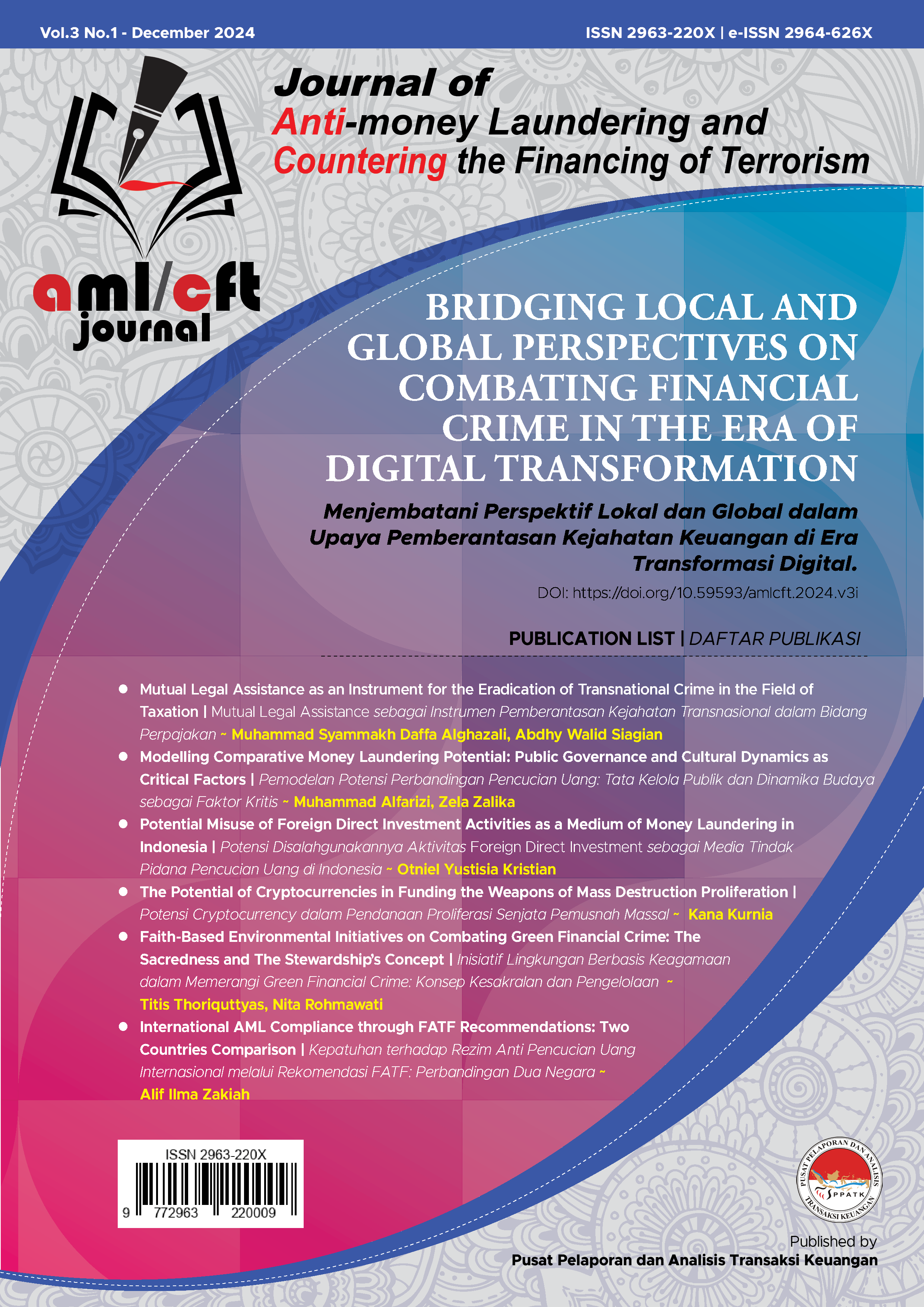
Potential Misuse of Foreign Direct Investment Activities as a Medium of Money Laundering Crimes in Indonesia
DOI:
https://doi.org/10.59593/amlcft.2024.v3i1.193Keywords:
FATF Recommendation, FDI, Money LaunderingAbstract
To attract significant foreign investment and boost national economic growth, it is essential to examine the risks of Foreign Direct Investment (FDI) misuse as a medium for Money Laundering (ML) in Indonesia. This study explores the potential misuse of FDI in facilitating ML, identifies the vulnerabilities, and recommends policy measures to address these risks. Using a normative legal research approach, the study found that FDI activities in Indonesia are vulnerable to misuse due to the lack of technical regulations mandating verification of shareholder authenticity and paid-up capital during company registration. Additionally, inadequate coordination between financial institutions, the Financial Transaction Reports and Analysis Center (INTRAC), and the Investment Coordinating Board (BKPM) exacerbates the issue. To mitigate ML risks in FDI, the study highlights the need to strengthen the anti-money laundering regime, enhance regulatory frameworks in the investment sector aligned with Financial Action Task Force (FATF) Recommendation 24 on transparency and beneficial ownership, and promote synergy among key stakeholders.
Downloads
References
Adam, Yang Chik. (2015). "Corporate Governance: Nominee Director The Gatekeeper" Social and Management Research Journal, Volume 12, No 2.
Amrani, Hanafi. (2015). Money Laundering Criminal Law: The Development of the Anti-Money Laundering Regime and Its Implications for the Basic Principles of State Sovereignty, Criminal Jurisdiction, and Law Enforcement (Indonesian: Hukum Pidana Pencucian Uang: Perkembangan Rezim Anti Pencucian Uang dan Implikasinya terhadap Prinsip Dasar Kedaulatan Negara, Yuridiksi Pidana, dan Penegakan Hukum). Yogyakarta: UII Press, 2015.
Ariani, Navey Varida. (2022). "Beneficial Owner: Mengenai Pemilik Manfaat dalam Tindak Pidana Korporasi" Jurnal Penelitian Hukum De Jure Balitbangkumham, Volume 22, No 2.
Asia/Pacific Group on Money Laundering. (2021). APG Yearly Typologies Report 2021
"Methods and Trends of Money Laundering and Terrorism Financing". Sydney: APG Secretariat.
Asia/Pacific Group on Money Laundering, "Introduction to APG Typologies" https://apgml.org/methods-and-trends, accessed on 5 February 2024.
Badan Koordinasi Penanaman Modal (BKPM). (2021). Realization of DI-FDI Investment in the Fourth Quarter and January-December 2020 (Indonesian: Realisasi Penanaman Modal PMDN-PMA Triwulan IV dan Januari-Desember Tahun 2020). Jakarta: BKPM.
Badan Koordinasi Penanaman Modal (BKPM). (2022). Realization of DI-FDI Investment in the Fourth Quarter and October-December 2021 (Indonesian: Realisasi Investasi PMA & PMDN Triwulan IV (Oktober-Desember) 2021). Jakarta: BKPM.
Bank Indonesia. (2021). A Study of the Typology of Money Laundering, Terrorism Financing and Financing of the Proliferation of Weapons of Mass Destruction (Indonesian: Kajian Tipologi Tindak Pidana Pencucian Uang, Tindak Pidana Pendanaan Terorisme dan Pendanaan Proliferasi Senjata Pemusnah Massal). Jakarta: Bank Indonesia.
Bashri, Yanto. (2003). "Where to Go for Indonesia's Economic Development, Prism of Thought by Prof. Dr. Dorodjatun Kuntjoro-Jakti (Indonesian: Mau kemana Pembangunan Ekonomi Indonesia, Prisma Pemikiran Prof. Dr. Dorodjatun Kuntjoro-Jakti). Jakarta: Predna Media.
Biswas, A.K., J. Von Hagen, and S. Sarkar. (2022). "FDI Mismatch, trade mis-reporting, and hidden capital movements: The USA-China case", Journal of International Money and Finance, Volume 120, February 2022. https://doi.org/10.1016/j.jimonfin.2021.102534
Damanik, Boy Andreas. (2022). "Juridical Review of the Obligation to Report Investment Activities (LKPM) Online based on the Regulation of the Investment Coordinating Board of the Republic of Indonesia Number 17 of 2015 (Indonesian: Tinjauan Yuridis Kewajiban Laporan Kegiatan Penanaman Modal (LKPM) secara Online berdasarkan Perka Badan Koordinasi Penanaman Modal Republik Indonesia Nomor 17 Tahun 2015)" Jurnal Law of Deli Sumatera, Volume 2, No 1, December 2022.
Darmadji, T. dan H.M. Fakhruddin. (2012). Capital Markets in Indonesia (Indonesian: Pasar Modal di Indonesia). Jakarta: Salemba Empat.
Fachriko, Maulana, Siti Mahmudah, Sartika Nanda Lestari. (2017). "Legal Protection for Consumers in the Provision of Virtual Office Services (Indonesian: Perlindungan Hukum bagi Konsumen dalam Penyediaan Jasa Virtual Office)" Diponegoro Law Journal, Volume 6 Nomor 2.
Fajarta, Carlos Roy. "Virtual Office Becomes a Trend During the Pandemic (Indonesian: Virtual Office Jadi Tren di Masa Pandemi)" https://www.beritasatu.com/ekonomi/690821/virtual-office-jadi-tren-di-masa-pandemi, Accessed on 29 November 2024.
Friedman, Lawrence M. (2001). American Law: An Introduction (Indonesian: Hukum Amerika: Sebuah Pengantar). Jakarta: Tatanusa.
Jaklic, A. and M. Svetlicic. (2003). Enhanced Transition Through Outward Internationalization. Burlington: Ashgate Publishing.
Hariyanto, "Virtual Office is a New Trend for Beginner Businessmen (Indonesian: Virtual Office jadi Tren Baru untuk Pebisnis Pemula)" https://www.industry.co.id/read/75974/virtual-office-jadi-tren-baru-untuk-pebisnis-pemula, Accessed on 29 November 2024.
Hukum, Aal Lumanul dan Abraham Yazdi Martin. (2015). "Money Laundering Crimes and Their Modes in the Perspective of Business Law (Indonesian: Tindak Pidana Pencucian Uang dan Modusnya dalam Perspektif Hukum Bisnis)," Jurnal Hukum De'rechtsstaat, Volume 1, Nomor 1, Maret 2015.
Kairupan, David. (2013). Legal Aspects of Foreign Modal Planting in Indonesia (Indonesian: Aspek Hukum Penanaman Modaal Asing di Indonesia). Jakarta: Kencana.
Kariaga, Hendra. (2018). "Relation of Investment Climate and Money Laundering Eradication in Indonesia," European Journal Business and Management, Volume 10, Nomor 21.
Kolotay, K. (2004). "Outward FDI from Central and East European Economics Countries", Economic of Planning, Volume 37. https://doi.org/10.1007/s10644-004-7506-z
Marzuki, Peter Mahmud. (2014). Introduction to Legal Research (Indonesian: Pengantar Penelitian Hukum). Jakarta: Prenadamedia Group.
Ndikumana, Leonce and Mare Sarr. (2019). "Capital Flight, Foreign Direct Investment and Natural Resources in Africa,"Resources Policy Journal, Volume 63 October 2019. https://doi.org/10.1016/j.resourpol.2019.101427
Noor, Henry Faizal. (2007). Managerial Economics (Indonesian Ekonomi Manajerial). Jakarta: Raja Grafindo Persada.
Pahlevi, Kevin, Paramita Prananingtyas, Sartika Nanda Lestari. (2017). "Juridical Analysis of the Use of Nominee Arrangement Shares Reviewed from Laws and Regulations in Indonesia (Indonesian: Analisis Yuridis Terhadap Penggunaan Saham Pinjam Nama (Nominee Arrangement) ditinjau dari Peraturan Perundang-Undangan di Indonesia)," Diponegoro Law Journal, Volume 6, No. 1.
Perbawa, I Ketut Sukawati Lanang Putra. (2015). "Money Laundering in the Indonesian Banking System (Indonesian: Tindak Pidana Pencucian Uang dalam Sistem Perbankan Indonesia)," Jurnal Advokasi Unissula, Volume 5, No. 1 March 2015.
Perez, M. Fabricio, Josef C. Brada, Zdenek Drabek. (2011). "Illicit Money Flows as Motives for FDI: Evidence from a Sample of Transition Economies,"Journal of Comparative Economies, March 2011.
Putri, Rr. Nurul Rahmah Cahyo. "The Effectiveness of INTRAC and AUSTRAC Cooperation in Eradicating the Crime of Terrorism Financing in Indonesia in 2014-2017 (Indonesian: Efektivitas Kerjasama PPATK dan AUSTRAC dalam Memberantas Tindak Pidana Pendanaan Terorisme di Indonesia Tahun 2014-2017)". Journal of International Relations Universitas Diponegoro, Volume 5, No 4.
Reuter, Peter and Edwin M. Truman. (2005). Chasing Dirty Money: The Fight Against Money Laundering. Washington: Peterson Institute.
Sarwedi. (2002). "Foreign Direct Investment in Indonesia and Factors Influencing It (Indonesian: Investasi Asing Langsung di Indonesia dan Faktor yang Mempengaruhinya)", Jurnal Akuntansi & Keuangan Vol. 4, No. 1, May 2002.
Satrio, J. (1995). The Law of Covenant, the Covenant Born of Covenant (Indonesian: Hukum Perikatan, Perikatan yang Lahir dari Perjanjian). Bandung: Citra Aditya Bakti.
Schneider, Friedrich and Ursula Windischbauer. (2008). "Money Laundering Some Facts," European Journal of Law and Economics. https://doi.org/10.1007/s10657-008-9070-x
Sekretariat Kabinet RI, "Inauguration of the Opening of the 2023 National Investment Coordination Meeting, at the Rafflesia Grand Ballroom of Balai Kartini, DKI Jakarta Province, December 7, 2023 (Indonesian: Peresmian Pembukaan Rapat Koordinasi Nasional Investasi 2023, di Rafflesia Grand Ballroom Balai Kartini, Provinsi DKI Jakarta, 7 Desember 2023)" https://setkab.go.id/peresmian-pembukaan-rapat-koordinasi-nasional-investasi-2023, Accessed on 5 February 2024.
Sembiring, Sentosa. (2018). Investment Law, Discussion Complemented by Law Number 25 of 2007 concerning Investment (Indonesian: Hukum Investasi, Pembahasan Dilengkapi dengan Undang-Undang Nomor 25 Tahun 2007 tentang Penanaman Modal). Jakarta: Nuansa Aulia.
Soekanto, Soerjono dan Sri Mamudji. (2001). Normative Law Research: A Brief Goal (Indonesian: Penelitian Hukum Normatif: Suatu Tujuan Singkat). Jakarta: Raja Grafindo Persada.
Syakur, Syahrijal. (2020). The Urgency of Regulating Nominee Agreements in Indonesia to Prevent Money Laundering Crimes (Indonesian: Urgensi Pengaturan Nominee Agreement di Indonesia untuk Mencegah Tindak Pidana Pencucian Uang). Jakarta: PPATK.
Tim Riset dan Pengembangan PPATK. (2021). Money Laundering Typology Based on Court Decisions on Money Laundering Cases in 2020 (Indonesian: Tipologi Pencucian Uang Berdasarkan Putusan Pengadilan atas Perkara Tindak Pidana Pencucian Uang Tahun 2020). Jakarta: Pusat Pelaporan dan Analisis Transaksi Keuangan.
Toan, Bui Huu. (2022). "Effects of Foreign Direct Investment on Trade-Based Money Laundering: The Case of Vietnam", Cogent Social Sciences Journal, Vol. 8, Issue 1, November 2022. https://doi.org/10.1080/23311886.2022.2132672
Tunggal, Iman Sjahputra dan Amin Widjaja Tunggal. (2002). Building Good Corporate Governance (GCG) (Indonesian: Membangun Good Corporate Governance (GCG)). Jakarta: Harvarindo.
Wicaksono, Lucky Suryo. (2016). "Legal Certainty of Nominee Agreement for Limited Liability Company Share Ownership (Indonesian: Kepastian Hukum Nominee Agreement Kepemilikan Saham Perseroan Terbatas)" Jurnal Hukum Ius Quia Iustum, Volume 23, January 2016. https://doi.org/10.20885/iustum.vol23.iss1.art3
Widjaja, Gunawan. (2008). "Nominee Shareholders in the Perspective of the New Law and the New Investment Law and Its Problems in Practice (Indonesian: Nominee Shareholders dalam Perspektif UUPT Baru dan UU Penanaman Modal Baru Serta Permasalahannya Dalam Praktik)" Jurnal Hukum dan Pasar Modal, Volume 3, Edisi 4 August-December 2008.
Widyaningrum, Hesti. (2018). "The Existence of Corruption Eradication in Indonesia's International Investment Treaties (Indonesian: Eksistensi Pemberantasan Korupsi dalam Perjanjian Investasi Internasional Indonesia)" Jurnal Integritas, Volume 4, No 2, Desember 2018. https://doi.org/10.32697/integritas.v4i2.275
FATF Recommendation 24.
Law Number 25 of 2007 concerning Investment. (Indonesian:Undang-Undang Nomor 25 Tahun 2007 tentang Penanaman Modal).
Law Number 40 of 2007 concerning Limited Liability Companies. (Indonesian: Undang-Undang Nomor 40 Tahun 2007 tentang Perseroan Terbatas.)
Law Number 8 of 2010 concerning the Prevention and Eradication of Money Laundering Crimes. (Indonesian: Undang-Undang Nomor 8 Tahun 2010 tentang Pencegahan dan Pemberantasan Tindak Pidana Pencucian Uang).
Law Number 11 of 2020 concerning Job Creation. (Indonesian: Undang-Undang Nomor 11 Tahun 2020 tentang Cipta Kerja.
Presidential Regulation Number 13 of 2018 concerning the Application of the Principle of Recognizing Beneficial Owners in the Context of the Prevention and Eradication of Money Laundering and Terrorism Financing Crimes. (Indonesian: Peraturan Presiden Nomor 13 Tahun 2018 tentang Penerapan Prinsip Mengenali Pemilik Manfaat dalam rangka Pencegahan dan Pemberantasan Tindak Pidana Pencucian Uang dan Tindak Pidana Pendanaan Terorisme).
Regulation of the Investment Coordinating Board Number 3 of 2021 concerning an Electronically Integrated Risk-Based Business Licensing System. (Indonesian: Peraturan Badan Koordinasi Penanaman Modal Nomor 3 Tahun 2021 tentang Sistem Perizinan Berusaha Berbasis Risiko Terintegrasi Secara Elektronik).
Regulation of the Investment Coordinating Board of the Republic of Indonesia Number 2 of 2020 concerning the Strategic Plan of the Investment Coordinating Board for 2020-2024.. (Indonesian: Peraturan Badan Koordinasi Penanaman Modal Republik Indonesia Nomor 2 Tahun 2020 tentang Rencana Strategis Badan Koordinasi Penanaman Modal Tahun 2020-2024.)
INTRAC Regulation Number 1 of 2021 concerning Procedures for Submitting Reports on Suspicious Financial Transactions, Cash Financial Transactions, and Financial Transactions for Fund Transfers from and to Abroad through the GOAML Application for Financial Service Providers. (Indonesian: Peraturan PPATK Nomor 1 Tahun 2021 tentang Tata Cara Penyampaian Laporan Transaksi Keuangan Mencurigakan, Transaksi Keuangan Tunai, dan Transaksi Keuangan Transfer Dana dari dan ke Luar Negeri melalui Aplikasi GOAML Bagi Penyedia Jasa Keuangan).
INTRAC Regulation Number 15 of 2021 concerning Procedures for Requesting Information to the Financial Transaction Reporting and Analysis Center. (Indonesian: Peraturan PPATK Nomor 15 Tahun 2021 tentang Tata Cara Permintaan Informasi ke Pusat Pelaporan dan Analisis Transaksi Keuangan).
Circular Letter Number 06/SE/2016 concerning the Issuance of Domicile Certificates and Subsequent Permits for Virtual Office Users. (Indonesian: Surat Edaran Nomor 06/SE/2016 tentang Penerbitan Surat Keterangan Domisili dan Izin-Izin Lanjutannya bagi Pengguna Virtual Office.)
Downloads
Submitted
Accepted
Published
How to Cite
Issue
Section
License
Copyright (c) 2024 Otniel Yustisia Kristian

This work is licensed under a Creative Commons Attribution-ShareAlike 4.0 International License.
Authors who publish with this journal agree to the following terms:
Authors retain copyright and grant the journal right of first publication with the work simultaneously licensed under a Creative Commons Attribution-ShareAlike 4.0 International License that allows others to share the work with an acknowledgement of the work's authorship and initial publication in this journal.
Authors are able to enter into separate, additional contractual arrangements for the non-exclusive distribution of the journal's published version of the work (e.g., post it to an institutional repository or publish it in a book), with an acknowledgement of its initial publication in this journal.